
The phrase fighting words has a specific meaning in U.S. First Amendment law. It does not simply refer to rude, insulting, offensive, or angry language. Instead, the doctrine concerns a narrow category of personally directed expression that, under the relevant circumstances, may be likely to provoke an immediate breach of the peace.
The concept originated with the U.S. Supreme Court’s 1942 decision in Chaplinsky v. New Hampshire. Since then, the Court has repeatedly narrowed the circumstances in which government may punish speech under this theory. The result is an important distinction: speech can be deeply offensive without necessarily being legally classified as fighting words.
Read More: Zohran Mamdani: Biography, Career, Policies and Political Views
What Are Fighting Words?
In simple terms, fighting words are a narrow category of personally abusive expression that may fall outside First Amendment protection when the circumstances make the words inherently likely to provoke an immediate violent reaction.
The modern constitutional discussion begins with Chaplinsky v. New Hampshire, decided in 1942. The Supreme Court upheld Chaplinsky’s conviction under a New Hampshire law after the state court interpreted the law as applying to words likely to cause a breach of the peace.
The important point is that not every insult is a fighting word. The constitutional doctrine focuses on the relationship between the words, the person to whom they are directed, and the circumstances surrounding the encounter.
For example, a general political statement that angers people is not automatically a fighting word. Likewise, profanity printed on clothing or used in a political protest does not become a fighting word merely because someone finds it offensive.
Where Did the Fighting Words Doctrine Come From?
Chaplinsky v. New Hampshire (1942)
Chaplinsky v. New Hampshire is the foundational Supreme Court case involving fighting words.Walter Chaplinsky, a Jehovah’s Witness, was convicted under a New Hampshire statute after using offensive language toward a city marshal during a public confrontation. The Supreme Court unanimously upheld the conviction.
The Court reasoned that certain narrowly defined categories of expression have historically received less or no First Amendment protection. In the fighting-words context, the relevant concern was language directed at an individual that could provoke an immediate breach of peace.The decision established the basic constitutional foundation for the doctrine.
However, relying on Chaplinsky alone can give readers an incomplete picture of modern law. Later Supreme Court cases made the doctrine considerably narrower. The Library of Congress notes that although Chaplinsky remains the governing standard, the Supreme Court has not upheld another government action specifically on the fighting-words doctrine since that case.
How the Original Doctrine Has Changed
Over the decades, the Supreme Court has repeatedly rejected attempts to apply fighting-words laws broadly.
Courts have been particularly concerned when statutes are written so broadly that they could punish ordinary criticism, profanity, political expression, or unpopular opinions. This has helped transform fighting words from a relatively broad historical category into a very narrow modern doctrine.
Are Fighting Words Protected by the First Amendment?
The First Amendment protects freedom of speech from government restrictions, but the Supreme Court has recognized certain narrow categories of expression that can fall outside constitutional protection. Fighting words have traditionally been included among those categories.That does not mean the government can punish any speech that makes another person angry.
The modern doctrine requires a much closer connection between the expression and an immediate personal confrontation. In Cohen v. California, for example, the Supreme Court rejected a conviction based on an offensive expletive displayed on a person’s jacket. The Court emphasized that the expression was not a personal insult directed at a particular individual and that there was no evidence of the type of immediate confrontation associated with fighting words.
Fighting Words Examples
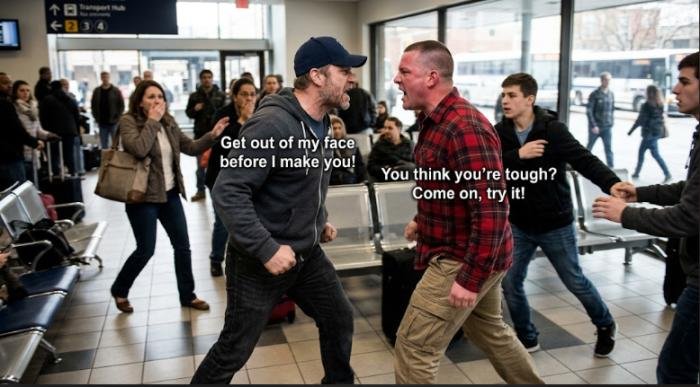
Because fighting words depend heavily on context, examples should be treated as illustrations rather than automatic legal classifications.
Examples That May Raise Fighting-Words Questions
Imagine a person deliberately directs an extremely abusive personal epithet at another individual during a face-to-face confrontation in circumstances where an immediate physical fight is realistically likely.That situation could raise a fighting-words issue.
Another example could involve personally directed abusive language accompanied by conduct designed to provoke an immediate physical confrontation.The important feature is not simply that the language is offensive. It is the combination of personal direction, circumstances, and likelihood of an immediate breach of peace.
Examples That Are Not Automatically Fighting Words
The following forms of expression do not become fighting words merely because they offend someone:
- Political criticism
- Strong disagreement with a public official
- Offensive political slogans
- Profanity used as political expression
- General criticism of a religious or social group
- Unpopular opinions
- Controversial public commentary
For instance, Texas v. Johnson involved the burning of a U.S. flag as political expression. The Supreme Court held that the conduct was protected expression and was not fighting words because it was not a direct personal insult or an invitation to exchange blows.
Fighting Words vs. Free Speech
The fighting-words doctrine illustrates a central tension in First Amendment law.On one side is the government’s interest in maintaining public order and preventing immediate violence. On the other is the constitutional principle that people must be able to express controversial, unpopular, and provocative ideas without government punishment merely because others dislike them.
The First Amendment therefore protects a broad range of expression, including speech that may be offensive. Cornell’s explanation of the First Amendment describes freedom of expression as protecting the ability to publicly convey thoughts, opinions, and ideas, particularly against government restriction.Fighting words represent a narrow exception, not a general rule allowing officials to silence offensive speakers.
Major Supreme Court Cases About Fighting Words
Chaplinsky v. New Hampshire (1942)
This is the starting point for the doctrine. The Court upheld Chaplinsky’s conviction and recognized the concept of words likely to provoke an immediate breach of peace.
Cohen v. California (1971)
Cohen demonstrated how narrow the doctrine had become. The defendant wore a jacket displaying an offensive expletive in a courthouse. The Supreme Court overturned his conviction, emphasizing that the expression was not a personal insult directed at a specific individual.The case is important because it demonstrates that vulgarity alone does not create fighting words.
Gooding v. Wilson (1972)
In Gooding, the Supreme Court examined a Georgia statute concerning abusive language. The Court’s analysis reinforced the requirement that a law must be sufficiently narrow and cannot sweep substantially protected expression into its prohibition. The Constitution Annotated identifies Gooding among the cases in which the Court rejected overly broad applications of fighting-words laws.
Texas v. Johnson (1989)
Texas v. Johnson is one of the most important cases for understanding the difference between provocative political expression and fighting words.Gregory Lee Johnson burned an American flag during a political demonstration. The Supreme Court held that the government could not punish the expressive conduct merely because it was offensive. The Court’s analysis also distinguished the conduct from direct personal insults or an invitation to fight.
R.A.V. v. City of St. Paul (1992)
R.A.V. added another important limitation.The Supreme Court accepted, for purposes of its analysis, that the prohibited expression fell within the fighting-words category. Nevertheless, the ordinance was unconstitutional because it selectively targeted certain viewpoints within that category.
The case demonstrates that declaring speech “fighting words” does not give government unlimited authority over the message.
How Courts Decide Whether Words Are Fighting Words
There is no universal checklist that mechanically determines the answer. Nevertheless, several questions are particularly useful when analyzing a potential case.
- Who was the speech directed toward?
- Was the expression a direct personal insult?
- What exactly was said or communicated?
- Was the speaker and listener engaged in a face-to-face encounter?
- What circumstances surrounded the statement?
- Was an immediate confrontation realistically likely?
- How is the relevant law written?
- Could the law punish protected expression as well as unprotected conduct?
- Does the law discriminate against particular viewpoints or subjects?
The Supreme Court’s history with fighting-words cases shows why context and statutory wording are critical. The Library of Congress specifically notes the Court’s repeated scrutiny of fighting-words laws for vagueness and overbreadth.
Fighting Words vs. Related First Amendment Categories
| Speech category | Basic concept | Main constitutional concern |
| Fighting words | Personally directed expression associated with an immediate breach of peace | Whether the expression falls within the narrow fighting-words doctrine |
| Incitement | Advocacy directed toward imminent unlawful action | Whether the speech is intended and likely to produce imminent lawless action |
| True threats | Serious expressions involving threatened violence | Whether the communication constitutes an unprotected threat |
| Offensive speech | Expression that may anger, shock, or offend | Whether there is an independent constitutional basis for government restriction |
| Hate speech | Expression attacking or demeaning people or groups | Whether government is impermissibly restricting speech because of its content or viewpoint |
Can You Be Punished for Using Fighting Words?
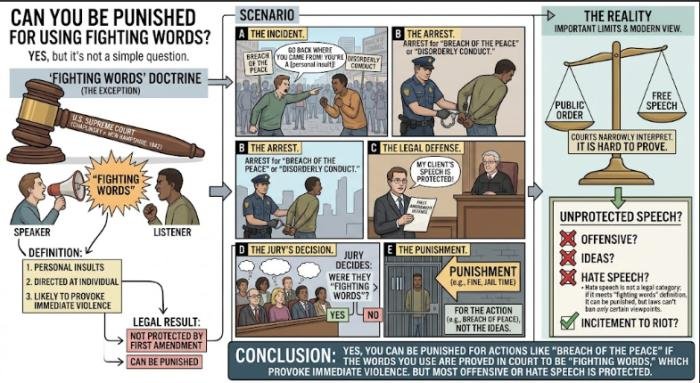
Potentially, but the answer depends on the circumstances and the applicable law.The government must operate within First Amendment limits. A statute that broadly prohibits insults, profanity, criticism, or annoying language may be unconstitutional if it reaches protected expression.
This is why the wording of the law matters. A narrowly tailored prohibition directed at constitutionally unprotected conduct presents a different constitutional question from a broad law allowing officials to punish speech simply because it is offensive.
The distinction between government and private actors is also important. The First Amendment primarily limits government action. Private organizations, employers, websites, and other private entities generally are not subject to the First Amendment in the same way government officials are.
Fighting Words and First Amendment Limits on Government
The First Amendment begins with a broad protection of freedom of speech. It generally prevents government from suppressing expression because officials or the public dislike its ideas.At the same time, the Supreme Court recognizes narrow categories of speech that can be regulated consistently with the Constitution. Fighting words are traditionally included within those categories.
But R.A.V. demonstrates an important qualification: even when speech falls within an otherwise regulable category, government cannot necessarily discriminate based on viewpoint or favored versus disfavored ideas.That limitation is essential to understanding modern fighting-words law.
Final Takeaway: What Fighting Words Mean Under U.S. Law
Fighting words occupy a small and carefully limited space within U.S. First Amendment law. The doctrine originated with Chaplinsky v. New Hampshire and concerns personally directed expression associated with an immediate breach of peace.Modern Supreme Court decisions, however, have substantially narrowed the doctrine. Cohen, Gooding, Texas v. Johnson, and R.A.V. demonstrate that profanity, political controversy, offensive ideas, and even deeply provocative expression cannot simply be labeled fighting words to justify government punishment.
The most important lesson is therefore simple: being offensive is not the same as being a fighting word. Personal direction, context, immediacy, statutory language, and constitutional protections all matter.This article provides general legal information about U.S. First Amendment law, not individualized legal advice. For a real dispute involving speech, criminal charges, or constitutional rights, a qualified attorney should evaluate the specific facts and applicable jurisdiction.
Frequently Asked Questions About Fighting Words
Q1. What does fighting words mean?
Ans: Fighting words are a narrow category of personally directed abusive expression that may be outside First Amendment protection when, under the circumstances, it is inherently likely to provoke an immediate breach of peace. The doctrine originated in Chaplinsky v. New Hampshire.
Q2. Are fighting words protected by the First Amendment?
Ans: Fighting words have traditionally been recognized as a category that can fall outside First Amendment protection. However, modern Supreme Court decisions have made the doctrine extremely narrow, and the government cannot punish speech simply because it is offensive.
Q3. What is an example of fighting words?
Ans: A hypothetical example would be an intensely abusive personal epithet deliberately directed at someone during a face-to-face confrontation where an immediate physical fight is realistically likely. Whether particular words qualify depends on the circumstances and applicable law.
Q4. Can an insult be considered fighting words?
Ans: Sometimes an insult could raise a fighting-words issue, but an insult is not automatically a fighting word. Personal direction, context, and the likelihood of an immediate confrontation are important considerations.
Q5. Are hate words automatically fighting words?
Ans: No. Offensive or hateful language does not automatically satisfy the fighting-words doctrine. R.A.V. v. City of St. Paul also demonstrates that government cannot selectively prohibit fighting words based on viewpoint.
Q6. What Supreme Court case established fighting words?
Ans: Chaplinsky v. New Hampshire, decided in 1942, established the foundational Supreme Court doctrine concerning fighting words.
Q7. What is the difference between fighting words and incitement?
Ans: Fighting words generally concern personally directed expression associated with an immediate confrontation. Incitement concerns advocacy directed toward producing imminent unlawful action and likely to produce it. The Supreme Court’s modern incitement framework comes from Brandenburg v. Ohio