
A vogue cover is more than the front page of a fashion magazine. At its strongest, it is a carefully constructed visual statement about fashion, photography, celebrity, beauty, and the cultural moment in which it appears. Some covers introduce a new model or designer, some capture a major shift in popular culture, and others become memorable because their imagery changes how audiences think about fashion itself.
Vogue has had an unusually long relationship with visual culture. The magazine began in New York in 1892, with its first issue featuring an illustrated cover by A. B. Wenzell. Over time, Vogue expanded from its early focus on society and fashion into areas including entertainment, beauty, politics, and the arts.
That history helps explain why certain Vogue covers continue to attract attention decades after their original publication. Their significance often comes from a combination of creative direction, photography, styling, personality, timing, and cultural relevance.
Read More: Earth Spinning Faster: Why Earth’s Rotation Is Speeding Up
What Is a Vogue Cover?
A Vogue cover is the principal visual representation of a particular issue of Vogue. It typically combines a photograph or illustration with the Vogue masthead and other design elements that identify the issue.
However, describing it simply as magazine packaging misses its editorial importance. The cover establishes the visual tone of an issue and can influence how readers interpret the subject inside. A successful cover can communicate an idea almost instantly through facial expression, clothing, composition, typography, lighting, and color.
Vogue’s own history describes the publication as a fashion authority that has expanded into culture, entertainment, beauty, politics, and the arts. That wider editorial scope means its covers can represent much more than seasonal clothing.
Why the Front Page Matters
A magazine cover has to perform several functions at once. It needs to identify the publication, attract attention, communicate an editorial idea, and represent the contents of the issue.
For Vogue, the cover also contributes to a long visual tradition. The publication has worked with photographers and artists including Irving Penn, Annie Leibovitz, Richard Avedon, Steven Meisel, Mario Testino, and others.
That combination of fashion publishing and image-making has helped turn individual covers into recognizable pieces of visual culture.
When Did Vogue First Begin Publishing Covers?
Vogue’s history begins in 1892. The first issue was published on December 17 of that year, and its cover featured an illustration of an unnamed debutante by A. B. Wenzell.The early publication was different from the modern Vogue that readers know today. It began as a weekly journal focused on society, fashion, and high life. Condé Nast acquired Vogue in 1909 and helped transform the publication into a major fashion title.
This early history is important because it shows that Vogue’s relationship with social identity and cultural status was present from the beginning. The magazine did not start solely as a photography publication. Its visual language developed alongside changes in fashion, publishing technology, and society.
From Society Journal to Fashion Authority
Under Condé Nast, Vogue increasingly emphasized high-quality fashion journalism, photography, illustration, and luxury advertising. The publication developed a visual identity that connected clothing with broader ideas about taste, status, modernity, and culture.Its transformation also demonstrates why the history of a vogue cover cannot be separated from the history of fashion media itself.
How Vogue Covers Changed Over Time
| Era | Major Cover Characteristics | Broader Significance |
| 1890s–early 1900s | Illustrated society and fashion imagery | Fashion connected with social life and status |
| Early–mid 20th century | Illustration gradually shared space with photography | Visual fashion journalism expanded |
| Mid–late 20th century | Sophisticated fashion photography and model imagery | Photographers became major creative figures |
| 1980s–1990s | Supermodels, experimentation, and strong visual concepts | Fashion models became global celebrities |
| 2000s onward | Greater emphasis on celebrity and cultural personalities | Fame and fashion became increasingly interconnected |
| Digital era | Print covers alongside digital and social presentation | Covers became shareable global visual content |
The Era of Illustrated Vogue Covers
Illustration played a central role in Vogue’s early visual identity. Before photography became the dominant way to represent fashion, artists created drawings that communicated clothing, silhouettes, and social ideals.
Vogue’s archive contains fashion illustrations spanning decades, demonstrating how artists helped readers visualize trends before photography gradually overtook illustration.
Illustration has never completely disappeared, however. Vogue has continued to return to illustrated covers at important moments, demonstrating that older visual techniques can acquire new meaning in a digital environment.
The Rise of Fashion Photography
As photography became increasingly important to fashion publishing, the cover evolved into a more direct form of visual storytelling.The photographer could now capture fabric, movement, expression, location, lighting, and personality with increasing detail. This created opportunities for photographers to develop recognizable styles of their own.Vogue’s cover history includes major photographic figures such as Irving Penn, Richard Avedon, Annie Leibovitz, Steven Meisel, and Mario Testino.
Photography Becomes Part of Vogue’s Identity
Photography eventually became one of the defining features of Vogue’s visual language. A cover was no longer simply an image of clothing or a famous person. It could be a carefully staged portrait, a narrative scene, an experiment in composition, or a statement about changing beauty ideals.That evolution helped make fashion photography an important part of modern visual culture.
What Makes a Vogue Cover Iconic?
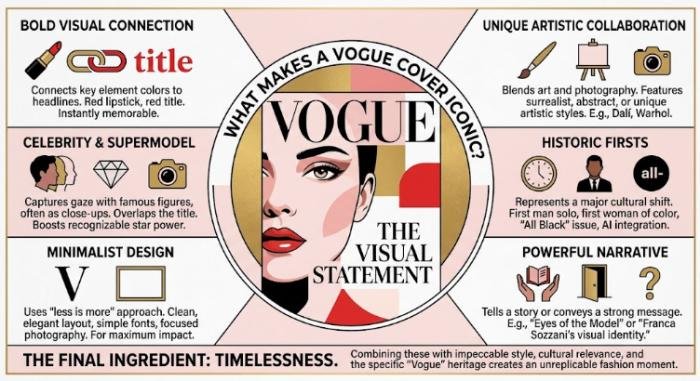
There is no single formula for an iconic cover. A beautiful photograph does not automatically become historically significant, and a commercially successful cover may not necessarily become a lasting cultural reference.Several characteristics often work together.
A Strong Visual Concept: An iconic cover usually has a clear visual idea. Composition, styling, lighting, setting, pose, and typography work together rather than appearing accidental.
The strongest images can often be recognized even without immediately seeing the magazine’s full title.
The Right Cover Subject: The person on the cover can strongly affect its cultural importance. Models, actors, musicians, athletes, designers, and other public figures have all occupied prominent places in Vogue’s cover history.But fame alone is not enough. The subject becomes more meaningful when the person represents something important about the moment in which the issue was published.
A Memorable Photographer: A photographer’s creative style can become inseparable from a cover’s identity.Irving Penn, for example, had an extraordinarily long relationship with Vogue. Vogue’s archival material identifies his work as part of the magazine’s important photographic legacy.The photographer therefore contributes not only technical skill but also a particular way of seeing fashion and people.
Cultural Timing: Timing can transform a strong image into a historically important one.A cover may appear when a particular fashion movement is emerging, when a new generation of models is gaining influence, or when public attitudes toward beauty and identity are changing.British Vogue has described its covers as reflections of the cultural landscape and societal shifts of their respective eras.
Originality and Creative Risk: Some covers become memorable because they do something unexpected.A different photographic style, unconventional styling, unusual casting, or innovative design can challenge readers’ expectations. In some cases, an image that initially seems unusual becomes more important as its historical context becomes clearer.
The Role of Fashion in a Vogue Cover
Fashion is at the center of Vogue’s identity, but clothing on a cover serves a broader purpose than simply showing what someone is wearing.
Clothing as Visual Storytelling
A garment can communicate an era, mood, personality, social identity, or artistic idea.A simple outfit can suggest minimalism. Elaborate couture can communicate fantasy or luxury. Street-influenced clothing can signal cultural change.
Styling, Hair, and Makeup
An effective cover is created through collaboration. Clothing works alongside hair, makeup, accessories, lighting, background, and pose.
Small decisions can significantly alter the final impression. A natural makeup approach may communicate intimacy, while dramatic makeup and elaborate styling can create theatricality.
How Covers Can Influence Fashion
A Vogue cover gives designers, models, and fashion trends enormous editorial visibility. When a particular garment, silhouette, or styling approach becomes associated with a memorable image, the cover can help establish that look as part of the visual vocabulary of its period.This is one reason fashion magazines are useful historical sources: they show not only what designers produced but also how fashion was presented to audiences.
The Role of Photography in Creating an Iconic Vogue Cover
Photography is one of the most important elements in Vogue’s history.Vogue’s archive emphasizes the work of photographers including Irving Penn, Annie Leibovitz, Mario Testino, Steven Meisel, Richard Avedon, Herb Ritts, and Bruce Weber.
Irving Penn and Vogue: Irving Penn’s relationship with Vogue lasted for decades. His work helped demonstrate how fashion photography could have a distinctive artistic language of its own.His images often relied on controlled composition, careful lighting, and an intense focus on the subject. That approach helped elevate fashion photography beyond simple product presentation.
Annie Leibovitz and Celebrity Portraiture: Annie Leibovitz is another major name associated with Vogue’s photographic history. Her work is especially relevant to the relationship between celebrity and fashion.Celebrity photography requires more than simply showing a recognizable face. The image must communicate personality, status, character, and the editorial idea of the issue.
Peter Lindbergh and the Supermodel Era: One of the clearest examples of a cover shaping fashion history is British Vogue’s January 1990 cover photographed by Peter Lindbergh.The image featured Naomi Campbell, Linda Evangelista, Tatjana Patitz, Christy Turlington, and Cindy Crawford. British Vogue identifies the cover as a defining image of the supermodel era.
The image became even more culturally significant because the same group of models was subsequently associated with George Michael’s “Freedom! ’90” music video and major fashion events.
Famous Vogue Cover Moments That Shaped Fashion and Culture
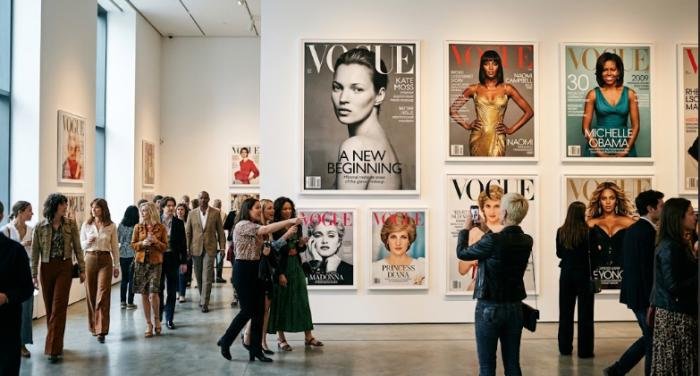
The 1990 British Vogue Supermodel Cover
Peter Lindbergh’s January 1990 image is frequently cited as one of British Vogue’s landmark covers.Its importance came partly from its casting. Instead of relying on a single dominant fashion image, it brought together five models whose personalities would become central to the decade.
The image helped establish a new model of fashion celebrity in which models themselves could become globally recognizable figures.
Kate Moss and the Grunge Moment
Kate Moss’s first British Vogue cover appeared in March 1993, photographed by Corinne Day.British Vogue describes the pared-back image as an important moment in the rise of fashion’s grunge aesthetic.
The cover illustrates how an image can become influential partly because it looks different from the dominant visual language that came before it.Rather than emphasizing highly polished glamour, the photograph presented a more stripped-back approach associated with the changing mood of early-1990s fashion.
Celebrity and the Modern Vogue Cover
Celebrity gradually became a major component of Vogue’s cover culture.Vogue’s own historical material notes the increasing importance of Hollywood and celebrity subjects, while its cover archive demonstrates the wide range of personalities who have appeared over the magazine’s history.
The shift reflects a broader change in popular culture. Fashion, film, music, sport, and social media increasingly overlap, meaning that a person’s influence can exist across several industries simultaneously.
How Vogue Covers Reflect Changing Ideas of Beauty
Beauty standards are not fixed. They change according to social attitudes, fashion movements, media representation, and cultural expectations.Vogue covers provide a visible record of those changes.
From Traditional Ideals to Broader Representation
Earlier fashion media often promoted relatively narrow ideals of beauty. Over time, Vogue covers have featured a broader range of identities, personalities, and forms of representation.
This does not mean that the history has been free from criticism or controversy. Rather, the evolution of covers can be studied as part of a larger conversation about who gets visibility in fashion media.
The Importance of Representation
When someone from an underrepresented background appears on a major fashion cover, the image can carry significance beyond clothing.It can communicate visibility, recognition, and changing expectations within an industry.
That is one reason cultural analysis is important when discussing a vogue cover. The image should be understood not only aesthetically but also in relation to its historical context.
Vogue Covers and Cultural Influence
How a Cover Can Capture Its Era
A memorable cover can act like a visual snapshot of its period.The clothing may reveal fashion trends. The photography can reveal contemporary aesthetic preferences. The cover subject can reflect changing ideas about fame. Even typography and graphic design can provide clues about the period.
British Vogue explicitly describes its cover history as a reflection of Britain’s cultural landscape and societal shifts.
Vogue as a Record of Social and Cultural Change
Vogue’s archive contains covers, advertisements, photographs, illustrations, and articles in their original contexts. The magazine describes this material as a record of fashion, social, and cultural ideas.This makes old Vogue issues valuable to researchers, historians, photographers, fashion students, and anyone interested in visual culture.
When Vogue Covers Challenge Expectations
A cover can become influential by questioning what a fashion magazine is expected to show.This can happen through casting, styling, photography, subject matter, or design. The impact may be immediate, or it may become clearer years later.
In fact, a cover does not have to be universally popular to be historically important. Sometimes the most interesting images are those that generated discussion or challenged established conventions.
How a Vogue Cover Is Created
Creating a major cover is a collaborative process rather than a single photographic moment.
Choosing the Cover Concept: Editors and creative teams consider the issue’s theme, timing, available subjects, fashion stories, and broader cultural context.The concept establishes what the cover should communicate.
Selecting the Subject: The subject must fit the editorial direction of the issue.A model might be selected because of a major fashion moment. An actor might appear alongside a film release. A musician may represent a changing cultural movement.
Photographer, Stylist, Hair, and Makeup: The photographer creates the visual language, while stylists, hair and makeup artists, set designers, creative directors, editors, and others contribute to the final image.
The Photo Shoot: During the shoot, the creative team makes decisions about lighting, composition, wardrobe, movement, expression, background, and framing.Hundreds of individual choices can influence a single final photograph.
Editing and Final Selection: After the shoot, the editorial team reviews the images and selects those that best represent the issue.The final image then has to work with the Vogue masthead and other cover elements.
What Is the Difference Between a Fashion Cover and an Iconic Vogue Cover?
Not every Vogue cover becomes iconic.A fashion cover can be attractive, commercially effective, and professionally produced without becoming historically memorable.An iconic cover generally has additional qualities:
- Memorability: The image remains recognizable.
- Originality: It introduces a distinctive visual idea.
- Cultural relevance: It reflects something meaningful about its era.
- Creative quality: Photography, styling, and design work together.
- Influence: The image affects fashion, photography, celebrity culture, or public discussion.
- Historical value: Its significance remains after the original issue has disappeared from newsstands.
The 1990 British Vogue supermodel cover demonstrates this distinction particularly well because its influence extended into music and runway culture.
Where Can You Find Historic Vogue Covers?
Readers interested in historical covers have several reputable resources.Vogue maintains extensive archival material, including original covers, photographs, illustrations, advertisements, and articles.Vogue has also reported making more than 15,000 images from its archive available through Google Arts & Culture, providing another digital route into fashion history.
Museum collections and institutional fashion archives can provide additional historical context, particularly when researching photography, designers, or major exhibitions.When researching a particular cover, it is best to verify its date, photographer, subject, and edition through the original Vogue archive or another authoritative source rather than relying solely on reposted images.
Final Thoughts: Why the Vogue Cover Still Matters
The history of the vogue cover is ultimately a history of changing visual culture.From A. B. Wenzell’s illustrated debut in 1892 to the sophisticated photography and multimedia presentation of today, Vogue covers have continually adapted to new technologies, fashion movements, personalities, and cultural expectations.
The most memorable covers succeed because several elements come together: an important subject, a compelling creative concept, strong photography or illustration, thoughtful styling, and a moment that resonates with the wider culture.The January 1990 Peter Lindbergh cover and Kate Moss’s 1993 British Vogue debut demonstrate how a single image can become associated with an entire fashion era.
That is what makes Vogue covers worth studying. They are not simply pictures placed on the front of magazines. They are visual records of fashion, fame, creativity, changing beauty ideals, and cultural history—and the most powerful ones continue to influence how those subjects are remembered.
Frequently Asked Questions About Vogue Covers
Q1: What was the first Vogue cover?
Ans: The first Vogue issue was published in December 1892, and its cover featured an illustration of an unnamed debutante by A. B. Wenzell. It established the magazine’s early connection between fashion, society, and visual presentation.
Q2: What makes a Vogue cover iconic?
Ans: An iconic Vogue cover usually combines a memorable subject, strong photography or illustration, distinctive styling, creative composition, originality, and cultural relevance. Its significance often becomes clearer when the image is viewed in the context of its historical period.
Q3: Who chooses the Vogue cover?
Ans: Cover selection is an editorial and creative process involving the leadership and creative teams of the relevant Vogue edition. The exact process can differ by edition and issue, so it is better not to assume that one individual makes every Vogue cover decision.
Q4: Who are some famous Vogue cover photographers?
Ans: Vogue’s history includes major photographers such as Irving Penn, Richard Avedon, Annie Leibovitz, Steven Meisel, Mario Testino, Herb Ritts, Bruce Weber, and Peter Lindbergh.
Q5: How has the Vogue cover changed over time?
Ans: It evolved from early illustrated covers into increasingly sophisticated photographic imagery, followed by eras dominated by supermodels, celebrities, experimental concepts, and digital distribution. The changes reflect both developments in technology and changes in fashion and popular culture.
Q6: Why are Vogue covers important to fashion history?
Ans: Vogue covers provide visual evidence of changing clothing, photography, beauty ideals, celebrity culture, and editorial design. Its extensive archive makes it possible to compare those changes across generations.
Q7: What is one of the most famous Vogue covers?
Ans: British Vogue’s January 1990 cover photographed by Peter Lindbergh is widely regarded as a landmark. It featured Naomi Campbell, Linda Evangelista, Tatjana Patitz, Christy Turlington, and Cindy Crawford and became strongly associated with the rise of the 1990s supermodel era.