

Connections is a popular daily word puzzle that challenges players to identify hidden relationships between words and organize them into four groups. Each puzzle brings a new set of words, making every day a fresh challenge for word game fans. If you are searching for Connections Hints Today Mashable, you may be looking for helpful clues that make confusing word combinations easier to solve.
With the right hints and a little logical thinking, you can spot possible connections, avoid common mistakes, and enjoy the puzzle without immediately revealing all the answers.
What Is the Connections Word Puzzle?
Connections is a daily word puzzle that challenges players to find relationships among sixteen words. The words are displayed together, but they belong to four separate groups. Each group contains four words connected by a common idea.
The difficulty comes from the fact that several words may appear to fit into more than one category. For example, a word might describe an object, form part of a familiar phrase, or have a meaning related to another word on the board. Players must determine which relationship the puzzle intends them to recognize.
Read More: Adstotally.com Review: Website, SEO, Ads & Guest Posts Guide
Unlike traditional word searches, Connections does not ask players to locate words hidden in a grid. Instead, it requires them to interpret words and compare their meanings. The answer depends on recognizing the intended relationship rather than simply identifying similar spelling patterns.
A typical puzzle includes four categories with different difficulty levels. Some groups are easy to identify because the words share an obvious characteristic. Others may involve expressions, multiple meanings, cultural references, or less familiar associations. The puzzle rewards players who remain flexible and consider several possibilities before committing to an answer.
For many people, Connections has become part of a daily routine. It offers a short mental challenge that can be completed during a morning break, a commute, or a quiet moment at home. The combination of accessible rules and challenging word relationships makes it appealing to a wide range of players.
Why Search for Connections Hints Today Mashable?
Players search for Connections Hints Today Mashable when they want assistance with the current daily puzzle. Sometimes, the words appear familiar, but the connection between them remains unclear. In other cases, a player may identify several possible groups and struggle to decide which one is correct.
Hints can help players move forward without immediately revealing every answer. A well-designed clue points toward a category while allowing the player to make the final connection independently. This approach preserves the central challenge of the game.
There are several reasons players may seek daily hints.
First, hints can save time when a puzzle contains confusing word relationships. Instead of repeatedly trying random combinations, players can focus on a more promising category.
Second, clues can help players avoid mistakes. Because incorrect selections may count against the available mistake limit, it is useful to examine a possible group carefully before submitting it.
Third, hints can teach players to recognize recurring puzzle patterns. Once someone becomes familiar with categories involving synonyms, expressions, word endings, or multiple meanings, similar relationships may become easier to identify.
Finally, puzzle hints can make the game more enjoyable for beginners. New players may not immediately recognize the different ways words can be connected. A small amount of guidance can help them build confidence while learning the rules.
Readers looking for help should check that an article refers to the correct puzzle date. Daily puzzles change, so a clue or answer from an earlier day may not apply to the current board.
Connections Puzzle Rules Explained
Before using hints, it helps to understand the basic rules of Connections. Knowing how the puzzle works makes it easier to interpret clues and avoid unnecessary mistakes.
The board contains sixteen words. Your objective is to separate those words into four groups of four. Each group must share a specific connection, and all sixteen words must be assigned to the intended groups.
Players select four words they believe belong together and submit their selection. If the group is correct, those words are removed from the unsolved portion of the board or otherwise marked as solved. If the selection is incorrect, the game indicates that the group does not match the intended category.
Players generally have a limited number of mistakes available, so random guessing is not the best strategy. It is more effective to study the entire board, identify strong relationships, and test possible groups carefully.
The puzzle may include words that serve as distractions. Two or three words might appear to belong together even though they are intended for different categories. These overlapping possibilities make the game more challenging and encourage players to examine every word before submitting a group.
The four categories are commonly differentiated by color after they are solved. In the standard version, yellow represents the easiest group, followed by green, blue, and purple as the difficulty increases. However, difficulty is subjective, and a category that seems easy to one player may be challenging to another.
The main objective is not merely to recognize four related words. It is to identify the exact relationship intended by the puzzle creator.
Common Types of Connections Categories
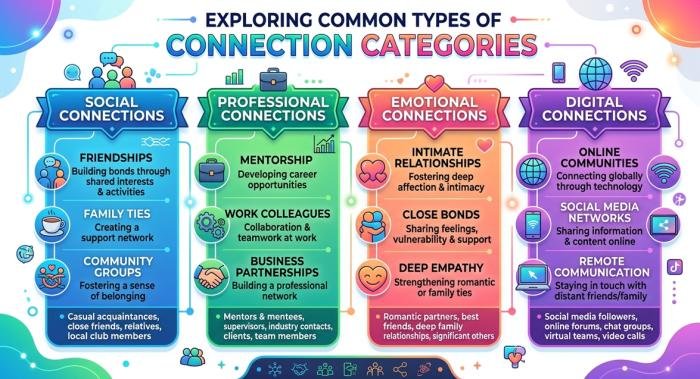
Understanding common category types can make it easier to recognize patterns in the daily puzzle. Although the specific categories change, several types of relationships appear frequently in word games.
Words With Similar Meanings
Synonyms are words that have the same or nearly the same meaning. A group might include terms that describe speed, happiness, intelligence, or size.
For example, words such as quick, rapid, swift, and speedy share a connection related to moving or happening quickly. This is a simple illustrative example rather than an answer to a particular daily puzzle.
When looking for synonyms, consider the meaning of each word rather than its spelling. Some words have several meanings, and only one may fit the intended group.
Words That Belong to the Same Category
Some groups contain different objects or concepts that share a broader classification. These might include kitchen tools, types of clothing, musical instruments, or items commonly found in an office.
The individual words do not need to be synonyms. Their connection comes from belonging to the same general category.
To identify this type of group, ask yourself what label could accurately describe all four words. If a single category fits every word naturally, the relationship may be worth considering.
Words Found in Common Expressions
Some Connections groups involve familiar phrases, idioms, or expressions. A word may appear unrelated to the others until you place it in a common expression.
For example, the words time, piece, break, and point can each appear in familiar expressions, but they do not automatically form a valid group. The exact words and intended relationship must be checked carefully.
When you suspect a phrase-based category, try combining the words with the same possible prefix, suffix, or surrounding expression. Avoid forcing a phrase that sounds unnatural simply to make the words fit.
Words With Multiple Meanings
Many English words have more than one meaning. A word might refer to an object in one context and an action in another. Connections puzzles can use these different meanings to create unexpected relationships.
For example, bark can refer to the outer covering of a tree or the sound made by a dog. Recognizing both meanings can help explain why a word appears beside items that initially seem unrelated.
If a word does not fit the obvious category, pause and consider whether it has another common definition.
Words Connected by Spelling or Structure
Some of the more challenging groups involve word structure rather than meaning. The words might share a prefix, contain the same ending, include a particular letter pattern, or form new words when combined with another term.
These connections can be difficult because players often focus on definitions first. If the meanings do not provide a clear pattern, examining spelling and word construction may reveal another possibility.
How to Use Connections Hints Today Mashable Effectively
Using hints effectively means receiving enough guidance to make progress without removing all the challenge. The best approach is to begin with your own observations and consult clues only when you need additional direction.
Start by reading all sixteen words slowly. Resist the urge to select the first four words that appear related. Instead, look for several possible connections and compare them.
Next, identify words that seem especially distinctive. A word with an unusual meaning, a familiar phrase association, or a strong relationship with another word may help reveal a category.
Once you have identified a possible group, consider what its category would be called. A clear category label should explain why all four words belong together. If you can explain the relationship only by giving each word a different justification, the group may not be correct.
If you remain stuck, seek a hint that describes the general theme rather than immediately showing the complete solution. A category-level clue can direct your attention toward a useful possibility while leaving room for independent reasoning.
After solving a group, review the remaining words. Removing four words can make other relationships easier to see because the board becomes less crowded with competing possibilities.
Finally, if you decide to check the complete answer, use it as a learning opportunity. Examine why each group works and why the other tempting combinations do not. This reflection helps build the pattern-recognition skills needed for future puzzles.
A Simple Reference Table for Solving Connections
The following table summarizes practical techniques you can use when working through the daily word puzzle. These are general strategies, not clues or verified answers for a specific day’s game.
| Puzzle challenge | Helpful approach | What to consider |
| Four words seem closely related | Identify their shared category | Can one clear label describe all four? |
| A word does not fit its obvious meaning | Consider alternative definitions | Could the word be used in another context? |
| Several words form familiar phrases | Test common expressions | Do the words complete the same phrase pattern? |
| Similar words appear in different possible groups | Compare the exact relationships | Which category fits every word most naturally? |
| No category seems obvious | Review spelling and word structure | Do the words share a prefix, suffix, or letter pattern? |
| You are unsure about a selection | Wait before submitting | Can you explain the connection for every word? |
| You have solved one group | Reassess the remaining words | Does removing the solved words reveal another pattern? |
| You have made an incorrect guess | Use the feedback carefully | Which assumption about the relationship may have been wrong? |
Strategies to Improve Your Connections Performance
Improving at Connections does not require an unusually large vocabulary. Although knowing many words is helpful, a systematic approach can make a significant difference.
Begin With the Most Obvious Group
Look for four words that share a clear and specific relationship. These may involve familiar objects, straightforward synonyms, or recognizable categories.
Solving an obvious group reduces the number of words you must consider. It can also help you identify relationships among the remaining words that were difficult to see at first.
However, avoid submitting a group merely because four words share a broad association. The intended connection should be precise enough to explain why those words belong together.
Search for More Than One Possible Connection
Do not assume that your first interpretation is correct. A word may fit a category that appears convincing but is not the intended solution.
For instance, several words might describe emotions, while some of those words may also appear in familiar expressions. The puzzle may be testing the second relationship rather than the first.
Write down possible category labels mentally before submitting your selection. Comparing alternative explanations can help you avoid a premature guess.
Pay Attention to Unusual Words
A less familiar word can be an important clue. It may belong to a category involving a specific definition, expression, or word pattern.
Instead of ignoring an unfamiliar term, consider its possible meanings and how it might relate to the other words. If necessary, consult a reliable dictionary after completing the puzzle to understand a connection you missed.
Avoid Overthinking Simple Relationships
While Connections sometimes includes tricky categories, not every group requires an obscure explanation. Players can waste time searching for complicated patterns when a straightforward category is available.
Start with ordinary meanings and familiar relationships. Move toward wordplay, alternative definitions, and less obvious associations when the simpler possibilities do not work.
Use Mistakes as Feedback
An incorrect selection can reveal that your interpretation was too broad or that one word belongs elsewhere. Rather than repeating a similar guess, reconsider the entire group.
Ask whether the four words share one precise characteristic or whether you connected them through several unrelated ideas. If the latter is true, search for a stronger pattern.
Practice Consistently
Playing regularly helps you become familiar with different category styles. Over time, you may notice that you are quicker at identifying synonyms, expressions, word combinations, and alternate meanings.
You can also review completed puzzles to understand which relationships caused difficulty. The purpose of practice is not simply to increase speed but to develop a more reliable way of thinking through the board.
Why Daily Word Puzzles Are Enjoyable
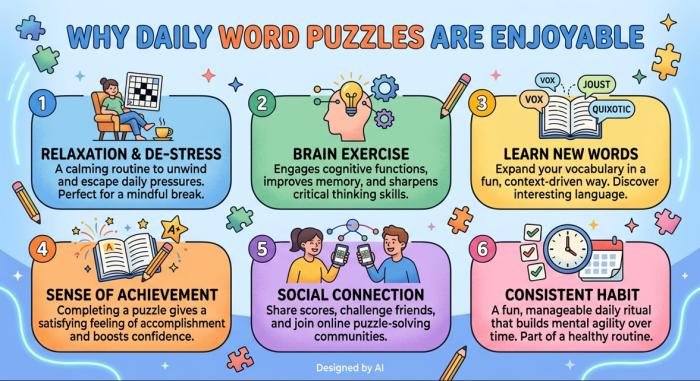
Daily word puzzles offer a convenient way to challenge the mind without requiring a lengthy commitment. A single puzzle can encourage concentration, careful reading, and flexible thinking.
Connections is particularly appealing because it asks players to interpret information from several angles. A word’s meaning, spelling, and use in a phrase can all contribute to its possible relationships. This makes the game more varied than a puzzle that depends on a single type of clue.
The shared daily format also creates opportunities for conversation. Friends, family members, and coworkers can compare their solutions, discuss difficult categories, and explain the connections they noticed.
Some players enjoy finishing without help, while others prefer occasional hints. Both approaches can be satisfying as long as the game remains enjoyable. There is no need to solve every puzzle perfectly to benefit from the experience.
Word games can also encourage curiosity about language. When a surprising connection appears, players may become interested in the history, meaning, or usage of a word. Looking up an unfamiliar term after finishing the game can turn a difficult puzzle into a useful vocabulary exercise.
Where to Find Reliable Daily Connections Hints
Players searching for Connections Hints Today Mashable should begin by checking whether the article they find corresponds to the current date. Daily puzzle coverage can change frequently, and older pages may remain available in search results long after their clues are no longer relevant.
Mashable is one possible source for daily puzzle assistance. Its puzzle-related coverage may offer hints, category guidance, or answers, depending on the article. Readers should check the page’s date and confirm that the title refers to the puzzle they are currently playing.
The official Connections game is another important reference because it provides the actual puzzle board and confirms whether a submitted group is correct. Using the game alongside an external hint article can help you distinguish between a general clue and a confirmed solution.
When reading a hint article, choose the amount of assistance that suits your needs. If you want to preserve the challenge, stop after reading a category clue. If you have already exhausted your attempts or want to understand the solution, reading the complete answer may be more useful.
It is also worth remembering that hints are intended to support the puzzle experience, not guarantee a perfect result. An article may use a different explanation from the one you initially considered, but the final category should still account for all four words accurately.
How to Enjoy Connections Without Spoiling the Answer
A good puzzle experience balances challenge with progress. If you want to use hints while preserving the satisfaction of solving the game, follow a few simple habits.
First, give yourself time to examine the board before opening a hint page. Even a short period of independent thinking can help you notice a relationship you might otherwise overlook.
Second, use progressive hints whenever they are available. Begin with a broad category clue, then seek a more specific hint only if the first one does not help.
Third, avoid reading the complete answer accidentally. Puzzle articles sometimes display category names or solutions close to the introductory text. If you want only a clue, scroll carefully and stop once you have enough information.
Fourth, return to the puzzle after receiving a hint. Try to identify the four words yourself rather than copying a solution without examining the connection.
Finally, take a moment to review the answer after finishing. Understanding the logic behind a group can be more valuable than merely knowing which words belong together.
These habits make daily puzzle assistance more useful and help maintain the sense of accomplishment that makes Connections enjoyable.
Conclusion
Finding the right approach to Connections can make the daily puzzle more enjoyable and rewarding. By reviewing the words carefully, considering different meanings, and using hints when needed, you can improve your problem-solving skills and recognize tricky word patterns more easily. Connections Hints Today Mashable can be a helpful search term when you need guidance with the current puzzle, but remember to check the date to ensure the clues match the correct challenge.
Whether you solve every group on your own or use occasional hints, each puzzle offers another opportunity to sharpen your thinking and enjoy the fun of word games.
FAQs about connections hints today mashable
Q1. What does Connections Hints Today Mashable mean?
Ans: Connections Hints Today Mashable refers to searches for daily Connections puzzle clues and related assistance associated with Mashable. Players use this phrase when they want help identifying word groups, interpreting tricky relationships, or checking a solution for the current puzzle.
Q2. How does the Connections puzzle work?
Ans: Connections presents sixteen words that must be divided into four groups of four. Each group shares a specific relationship. Players select four words at a time and submit their choices, trying to solve the entire board while staying within the game’s mistake limit.
Q3. Does Mashable provide answers to the daily Connections puzzle?
Ans: Mashable publishes puzzle-related content, including daily puzzle coverage when available. The exact content can vary, so check the article’s publication date and confirm that it covers the puzzle you are playing. Do not assume that an older answer applies to today’s board.
Q4. What is the best way to solve Connections without hints?
Ans: Read all sixteen words, identify obvious relationships, and look for precise category labels. Consider synonyms, shared categories, familiar expressions, and alternative word meanings. Before submitting a group, make sure every word fits the same connection naturally.
Q5. Why are some Connections categories difficult to identify?
Ans: Some categories are based on less common meanings, wordplay, familiar expressions, or relationships that are not immediately obvious. Other words may appear to fit multiple groups, making it necessary to compare different possibilities before choosing the intended category.
Q6. Can hints help improve my Connections skills?
Ans: Yes. Hints can direct your attention toward a relationship you may have missed. Reviewing why a category works can help you recognize similar patterns in future puzzles. For the greatest benefit, try solving part of the board independently before checking a clue.
Q7. Are Connections hints the same every day?
Ans: No. The daily puzzle changes, so the relevant words, categories, clues, and answers change as well. Always check the date on a hint article to ensure it matches the puzzle you are trying to solve.
Q8. Should I read the complete Connections answer before playing?
Ans: That depends on your preference. If you enjoy solving the puzzle independently, begin with the board and consult a general hint only when necessary. If you are stuck or want to review the solution, reading the complete answer can help explain the intended relationships.

1 Comment
Pingback: How to Update ETSJavaApp by ETrueSports: Easy Update Guide