
The trey reed hanging case has remained a subject of public attention since September 2025, when 21-year-old Delta State University student Demartravion Trey” Reed was found dead on the university’s campus in Cleveland, Mississippi.
The case quickly attracted national attention. Authorities ultimately announced that Reed’s death was a suicide, while his family questioned the official conclusion and sought an independent autopsy. Since then, social media has produced numerous claims about what happened, making it increasingly important to distinguish verified information from speculation.
As of September 2026, the central public facts are relatively clear: the Mississippi State Medical Examiner determined that Reed died from hanging and classified the manner of death as suicide. His family has disputed that conclusion, and the independent autopsy arranged for the family has not been publicly released.
Who Was Trey Reed?
Demartravion “Trey” Reed was a 21-year-old student from Grenada, Mississippi, who attended Delta State University in Cleveland. Delta State confirmed his death in September 2025 and expressed condolences to his family, friends and the wider university community. The university also said counseling and support services were made available following the tragedy.
Reed’s death was particularly difficult for the campus because it occurred at the university itself and involved a young student whose life was cut short. The circumstances also generated wider public concern because Reed was Black and was found hanging from a tree in Mississippi, a state whose history includes racially motivated lynchings. That historical context became an important part of the public discussion, although historical context by itself does not establish what happened to Reed.
Read More: Backtofrontshow Pricing: Plans, Costs & Value for 2026
What Happened in the Trey Reed Hanging Case?
On the morning of September 15, 2025, Reed was found hanging from a tree near the central campus area of Delta State University. University police were notified at approximately 7:05 a.m. Authorities identified Reed as the deceased student later that day. The university immediately contacted his family and began working with local authorities.
Early public statements from authorities said there was no immediate indication of foul play. That point became important because online speculation began almost immediately. Social media posts circulated claims about possible injuries and other circumstances surrounding Reed’s death. Authorities subsequently emphasized that their preliminary examination had not found evidence consistent with an assault.
It is important to distinguish between what investigators initially reported and what people later claimed online. The existence of a rumor does not make the allegation an established fact.
What Did the Official Investigation Find?
The official investigation produced a specific conclusion. The Bolivar County Coroner’s preliminary examination reported no broken bones or injuries consistent with an assault. The coroner said there was no evidence at that stage suggesting Reed had been physically attacked before his death. A state autopsy followed.
On September 17, 2025, the Mississippi State Medical Examiner’s Office conducted an autopsy. On September 18, Cleveland police announced that the medical examiner had determined the cause of death was hanging and classified the manner of death as suicide. Authorities said the autopsy findings were consistent with the initial investigation. The distinction between “cause” and “manner” is useful here. The cause describes the physical cause of death, while the manner classifies the circumstances surrounding it. In Reed’s case, authorities publicly reported hanging as the cause and suicide as the manner.
Official findings at a glance
| Issue | Publicly reported information |
| Person | Demartravion “Trey” Reed |
| Age | 21 |
| University | Delta State University |
| Location | Cleveland, Mississippi |
| Date found | September 15, 2025 |
| Official cause of death | Hanging |
| Official manner of death | Suicide |
| Initial examination | No injuries consistent with assault were reported |
| Independent autopsy | Conducted, but final results have not been publicly released |
| Family position | Family has questioned the official ruling and sought further review |
Why Did Trey Reed’s Family Question the Official Ruling?
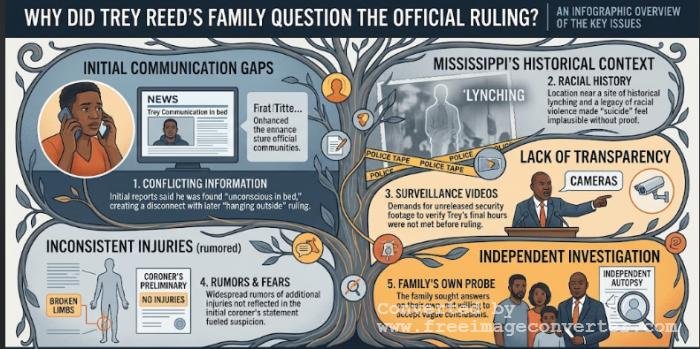
Reed’s family sought additional investigation after the initial ruling. Civil rights attorney Ben Crump became involved, and an independent autopsy was arranged. Colin Kaepernick’s Know Your Rights Camp Autopsy Initiative was reported to have funded the independent examination.
The family’s decision reflected its desire for additional scrutiny rather than proof, by itself, that the official ruling was incorrect. This distinction matters. A family requesting another autopsy does not automatically establish foul play. At the same time, families have a legitimate interest in seeking independent forensic review when they have unanswered questions about a loved one’s death.
Public concern also grew because of uncertainty surrounding investigative materials, including questions about surveillance footage and the handling of evidence. Authorities had indicated that video existed and was in the hands of investigators, but the contents of that footage were not publicly established in the reporting reviewed for this article.
What Is Known About the Independent Autopsy?
The independent autopsy is one of the most frequently searched aspects of the Trey Reed case. The examination was conducted by independent forensic pathologist Dr. Matthias I. Okoye. However, the final independent autopsy report has not been publicly released. This point is especially important because numerous social media posts have claimed that the second autopsy definitively proved foul play or found specific injuries.
Those claims should not be treated as established findings unless supported by the actual report or a reliable public statement from the forensic examiner. The Mississippi Free Press reported in July 2026 that Reed’s family still had not received the final independent autopsy results. The same reporting described how rumors about alleged findings had circulated even though the final report had not been released.
There have also been reports about preliminary discussions involving the independent examiner. But preliminary observations are not necessarily the same as a completed forensic conclusion. For that reason, the safest and most accurate description is simple: an independent autopsy was performed, but its final results have not been publicly released.
Trey Reed Case Timeline
September 15, 2025: Reed was found dead on the Delta State University campus. University officials and local authorities responded, identified him and notified his family. Authorities initially said they did not suspect foul play.
September 16, 2025: The Bolivar County Coroner’s Office reported that its preliminary examination did not show broken bones or injuries consistent with an assault. This helped shape the initial public understanding of the case.
September 17–18, 2025: The Mississippi State Medical Examiner performed the autopsy. On September 18, police announced the official finding that Reed’s cause of death was hanging and the manner was suicide.
Late September 2025: Reed’s family continued seeking independent scrutiny. An independent autopsy was arranged, with funding reported from Colin Kaepernick’s Know Your Rights Camp Autopsy Initiative.
October 2025: Reporting indicated that the independent autopsy had not yet produced a publicly available final report. This contributed to continued uncertainty and online speculation.
2026: The independent report remained unreleased. By July 2026, Reed’s family was publicly expressing frustration about the lack of access to the final findings and communication surrounding the case.
Separating Confirmed Facts From Online Rumors
The Trey Reed case demonstrates how quickly uncertainty can produce misinformation. Several claims have circulated online about injuries, foul play and what the second autopsy supposedly found. But without a publicly released final independent autopsy report, such claims cannot responsibly be presented as proven facts.
What has been established?
The following points are supported by official statements or reputable reporting:
- Reed was 21 years old.
- He was a Delta State University student.
- He was found dead on campus on September 15, 2025.
- Authorities conducted a preliminary examination.
- The Mississippi State Medical Examiner later performed an autopsy.
- The official ruling classified the death as suicide, with hanging listed as the cause.
- Reed’s family sought an independent autopsy.
- The independent autopsy was performed.
- The final independent autopsy report has not been publicly released as of the latest reporting reviewed for this article.
What remains unverified?
Claims that the independent autopsy definitively proved homicide or foul play remain unverified without the final report. Likewise, social media assertions should not be treated as equivalent to forensic evidence, police records or statements from medical examiners.
This is especially important in a case involving a death that has generated intense public emotion. Repeating an unverified claim can turn speculation into something that appears factual after it is repeated enough times.
Why the Case Received National Attention

The Trey Reed case received attention for reasons extending beyond the university. Reed was a young Black student found hanging from a tree in Mississippi. Because of the state’s painful history of racial violence, the circumstances immediately generated concern among family members, civil rights advocates and members of the public.
That historical context helps explain the intensity of the response, but it should not replace forensic evidence. The case also raised broader questions about trust in official investigations. When a family disputes a death ruling, an independent review can become an important part of establishing confidence in the process.
At the same time, responsible reporting requires restraint. The fact that questions remain does not mean every alternative explanation is equally plausible or supported by evidence. That balance is particularly important in the age of social media, where incomplete information can spread faster than verified investigative findings.
What Is the Latest Status of the Trey Reed Case?
As of September 2026, the most important update is that the independent autopsy’s final findings have still not been publicly released. The Mississippi Free Press reported in July 2026 that Reed’s family said it had not received the final independent autopsy results and had experienced prolonged communication problems with the attorney’s team.
That means there are two separate issues that should not be confused.First, the official state finding remains that Reed died by suicide, with hanging listed as the cause. Second, the independent review sought by the family has not produced a publicly available final report that can be independently evaluated.
Until that report is released, claims about what it definitively concluded should be treated cautiously. For readers following the case, this is the central fact to keep in mind: there is a documented official ruling, there is a family-requested independent examination, and the final findings of that independent examination remain unavailable publicly.
Why Accurate Reporting Matters
Cases involving unexpected deaths require careful language. A responsible article should not present rumors as facts, especially when those rumors concern alleged criminal conduct, forensic findings or the intentions of a deceased person.
It is also important to use respectful language when discussing suicide. Reed was a young person whose death affected family, friends, classmates and the broader Delta State community. The focus should remain on verified information and the people affected rather than sensationalizing the circumstances.
The best reporting can acknowledge unanswered questions without filling those gaps with speculation.That approach is particularly valuable in the Trey Reed case because the public record contains both an official medical conclusion and continuing requests from his family for independent review.
Final Thoughts
The Trey Reed hanging case remains sensitive because it combines a young student’s unexpected death, an official suicide ruling, a family’s continuing questions and an independent autopsy whose final findings have not been made public. The most reliable way to discuss the case is to separate confirmed information from allegations. Authorities concluded that Reed died by suicide, while his family has sought additional scrutiny. The independent autopsy was conducted, but its final report remains unavailable publicly as of the latest reporting.
Until new evidence or an official report changes the public record, readers should be cautious about social media claims presented as established facts. For anyone following the case, the most meaningful future development would be the release of credible forensic findings or an authoritative investigative update that can address the questions still surrounding Reed’s death.
FAQs
Q1: What happened to Trey Reed?
Ans: Demartravion “Trey” Reed, a 21-year-old Delta State University student, was found dead on the university’s campus in Cleveland, Mississippi, on September 15, 2025. Authorities later ruled his death a suicide, with hanging listed as the cause of death.
Q2: When did the Trey Reed hanging case happen?
Ans: Reed was found dead on September 15, 2025, at Delta State University in Cleveland, Mississippi. The official autopsy ruling was announced three days later, on September 18.
Q3: What was the official cause of Trey Reed’s death?
Ans: The Mississippi State Medical Examiner determined that the cause of death was hanging and classified the manner of death as suicide.
Q4: Did authorities find evidence of foul play?
Ans: Authorities publicly reported that the preliminary examination found no injuries consistent with an assault and that they did not initially suspect foul play.
Q5: Did Trey Reed’s family accept the suicide ruling?
Ans: No. Reed’s family questioned the official conclusion and sought additional independent review, including an independent autopsy.
Q6: Was Trey Reed’s second autopsy completed?
Ans: Yes. An independent autopsy was performed, but its final report has not been publicly released.
Q7: Has the independent autopsy proved foul play?
Ans: There is no publicly released final independent autopsy report establishing that conclusion. Various claims have circulated online, but they should not be treated as confirmed forensic findings without supporting documentation.