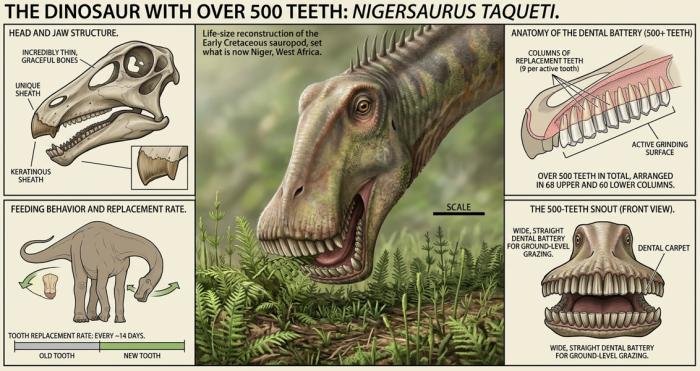
If you are searching for what dinosaur has 500 teeth, the answer is Nigersaurus taqueti. This unusual herbivorous sauropod lived during the Early Cretaceous and is famous for its remarkably wide muzzle and hundreds of rapidly replaceable teeth. Fossils have been found in Niger and other parts of North Africa. The Natural History Museum lists Nigersaurus at about 15 meters long and places it in the rebbachisaurid group of sauropods.
Nigersaurus was not famous simply because it had a large number of teeth. Its entire mouth was adapted to a specialized way of feeding. Instead of using powerful jaws to chew tough food, it appears to have cropped relatively soft, low-growing vegetation close to the ground. Its teeth wore down quickly, so the dinosaur continuously replaced them.
What Dinosaur Has 500 Teeth?
The dinosaur most commonly associated with 500 teeth is Nigersaurus taqueti. It was a four-legged sauropod and a member of the Rebbachisauridae family. The species was formally named in 1999 by Paul Sereno and colleagues, with the species name taqueti honoring French paleontologist Philippe Taquet.
The phrase “500 teeth” needs a little explanation. Nigersaurus did not have 500 large teeth exposed in its mouth at one time. Its jaws contained rows of functional teeth along with numerous replacement teeth developing behind them. Scientific research describes more than 500 active and replacement teeth within a single skull.
The teeth were arranged in dense columns, creating an efficient replacement system. So, if someone asks what dinosaur has 500 teeth, Nigersaurus is the straightforward answer, but the scientific story behind the number is even more interesting.
Read More: Angelina Jolie and Tom Brady: Dating Rumors & Facts
Who Was Nigersaurus?
Nigersaurus was a relatively small sauropod compared with the gigantic species that are usually associated with the group. It had a lightweight skull and an unusually broad muzzle. Researchers reconstructed its anatomy using fossil material collected from the Sahara region of Niger. Because many of its skull bones were extremely thin and delicate, understanding.
The animal required careful preparation and modern imaging techniques. CT scanning played an important role in reconstructing its unusual skull. Its scientific name means roughly “Niger lizard,” referring to the country where important fossils were discovered. The Natural History Museum classifies it as a sauropod and places its known range in Algeria, Niger, and Tunisia.
What Did Nigersaurus Eat?
Nigersaurus was a herbivore. Its skull and teeth indicate that it specialized in feeding on vegetation close to the ground. Rather than reaching high into trees, it likely used its wide muzzle to crop plants at a low level. Researchers have described its feeding behavior as similar to grazing, although it would be more accurate to say it was a specialized low-level browser.
Did Nigersaurus Eat Grass?
There is no reason to picture Nigersaurus eating modern grass like cattle do today. Nigersaurus lived during the Cretaceous Period, when plant communities were very different from modern grasslands. Its diet probably included low-growing vegetation such as ferns, horsetails, and other soft plants.
Research on its tooth wear supports the idea that it fed close to the ground. This is an important distinction because the word “grazing” can sometimes create the wrong image. Nigersaurus likely had a grazing-like feeding position, but it was not necessarily eating the same grasses that dominate many modern ecosystems.
How Did Its Teeth Help It Eat?
Its broad muzzle and tooth arrangement were particularly important. The teeth were positioned toward the front of the jaws and formed a wide cutting surface. Instead of grinding food like mammals with molars, Nigersaurus appears to have used its teeth more like a cropping or shearing mechanism.
Wear patterns on the teeth provide evidence for this feeding behavior. Paleontologists can study tooth shape and wear to make informed estimates about what extinct animals ate. The Smithsonian notes that tooth shape and arrangement can provide important clues about dinosaur diets.
How Big Was Nigersaurus?
Nigersaurus was large by everyday standards but relatively modest compared with the biggest sauropods. The Natural History Museum gives a length of approximately 15 meters, or about 49 feet. Other reconstructions have estimated it at around 9 meters long, showing why dinosaur size estimates should be treated cautiously.
Different fossils, reconstruction methods, and assumptions can produce different measurements. National Geographic reports an estimate of roughly 30 feet in length and about two tons in weight. The exact figure is less important than understanding its proportions. Nigersaurus was a relatively compact sauropod with a specialized head and feeding system rather than a giant high-browsing animal like some other members of the group.
How Did the Nigersaurus Teeth System Work?
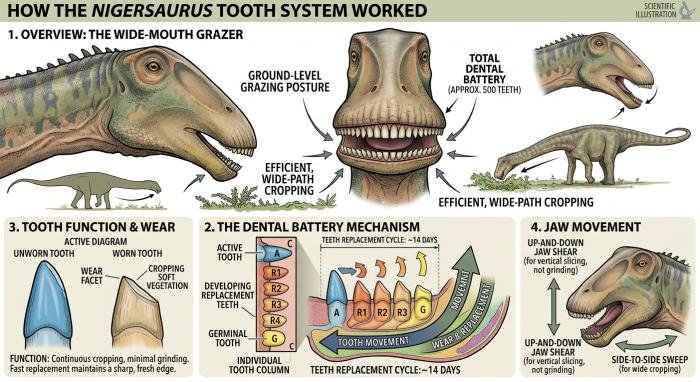
The teeth are the most remarkable feature of this dinosaur. When discussing what dinosaur has 500 teeth, many people imagine a mouth filled with hundreds of large, visible teeth. Nigersaurus was very different. Its jaws contained rows of small teeth with replacement teeth stacked behind them.
Scientific analysis of its skull found columns containing multiple replacement teeth, producing a total of more than 500 active and replacement teeth.
What Is a Dental Battery?
A dental battery is an arrangement in which teeth are organized into tightly packed rows or columns with replacement teeth ready to move into use. This strategy allowed Nigersaurus to keep functioning even as individual teeth became worn.
The system was particularly useful because its feeding behavior exposed its teeth to considerable wear. Low-growing plants could contain abrasive material, including silica, and vegetation collected near the ground could also contain grit or sand.
How Quickly Did Nigersaurus Replace Its Teeth?
This is one of the most extraordinary facts about the animal. National Geographic reports that researchers found evidence that individual Nigersaurus teeth could be replaced approximately every 14 days, with several replacement teeth developing behind an active tooth at the same time.
The original scientific research also documented an exceptionally rapid tooth replacement system and more than 500 active and replacement teeth in a single skull. Importantly, this does not mean that all of the dinosaur’s teeth fell out every two weeks. Tooth replacement occurred throughout the dental system, with individual teeth being replaced as they became worn.
Why Did Nigersaurus Need So Many Teeth?
The answer comes down to feeding and tooth wear. Nigersaurus appears to have repeatedly cropped low-growing vegetation. Its teeth were relatively slender and specialized for this task rather than being built for powerful crushing. Because the teeth wore down rapidly, the dinosaur needed an efficient way to replace them.
Its dental battery essentially provided a continuous supply of replacement teeth. This is a valuable example of evolutionary adaptation. The dinosaur did not have hundreds of teeth simply because having more teeth was advantageous. Its extraordinary tooth count was connected to the way its jaws, teeth, feeding behavior, and tooth replacement worked together.
What Was Nigersaurus’ Nickname?
Nigersaurus is often nicknamed the “Mesozoic Cow.” The nickname refers to its apparent low-level feeding strategy. Its broad, square-shaped muzzle and ground-level browsing behavior have been compared with modern grazing animals. National Geographic also describes its feeding style as similar to using a lawn mower because of its ability to crop low vegetation.
However, “Mesozoic Cow” is only an informal nickname. Nigersaurus was a dinosaur and had no close relationship with modern cattle. The comparison is useful because it helps people visualize its feeding position: instead of reaching high into trees, Nigersaurus probably spent much of its feeding time close to the ground.
Where Did Nigersaurus Live?
Nigersaurus lived in North Africa, with important fossils discovered in Niger. Fossil material has also been identified in Algeria and Tunisia. The Natural History Museum places the animal in the Early Cretaceous, approximately 121–99 million years ago. The environment was dramatically different from the modern Sahara.
During the Cretaceous, the region contained ecosystems capable of supporting diverse plant-eating and meat-eating animals. This ancient setting helps explain Nigersaurus’ feeding strategy. Different herbivorous dinosaurs could specialize in different levels of vegetation, reducing competition for the same food resources.
How Was Nigersaurus Discovered?
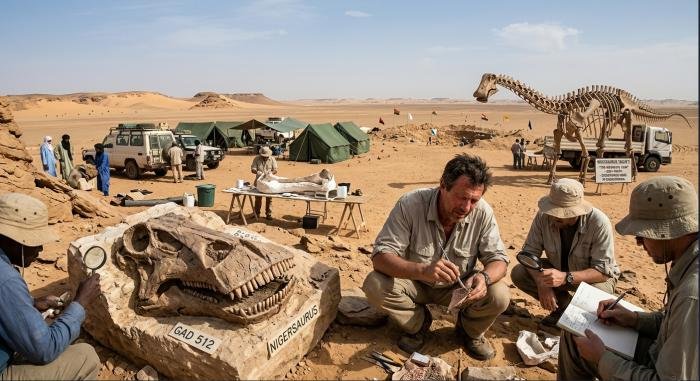
French paleontologist Philippe Taquet discovered important fossils of the dinosaur during fieldwork in Niger in the 1970s. Later expeditions recovered additional material that helped scientists understand its unusual anatomy. Paul Sereno and colleagues formally described and named Nigersaurus taqueti in 1999.
Later discoveries provided much better information about its skull and skeleton. One challenge was that many of its skull bones were extremely delicate. Modern CT scanning helped researchers reconstruct the skull digitally and study structures that were difficult to interpret from individual fossil fragments.
Nigersaurus Compared With Other Sauropods
| Feature | Nigersaurus | Many Other Sauropods |
| Diet | Herbivorous | Herbivorous |
| Feeding level | Mostly low vegetation | Often higher vegetation |
| Muzzle | Broad and straight-edged | Usually less specialized |
| Teeth | Hundreds of active and replacement teeth | Varies by species |
| Tooth replacement | Extremely rapid | Varies considerably |
| Body size | Relatively modest | Some were enormous |
| Famous adaptation | Specialized dental system | Often long neck and large body |
Did Nigersaurus Have the Most Teeth of Any Dinosaur?
It is safer not to describe Nigersaurus as definitively having the most teeth of every dinosaur. The popular association with 500 teeth comes from its unusually large number of active and replacement teeth.
Some other herbivorous dinosaurs, especially hadrosaurs, also had highly developed dental batteries. The important point is that Nigersaurus had an extraordinary dental system for a sauropod. Its teeth were connected directly to its specialized low-browsing lifestyle.
10 Quick Facts About Nigersaurus
- Nigersaurus was a herbivorous sauropod.
- It lived during the Early Cretaceous.
- Its fossils are known from North Africa.
- Its scientific name is Nigersaurus taqueti.
- It had an unusually wide muzzle.
- Its jaws contained more than 500 active and replacement teeth.
- Its teeth were replaced extremely quickly.
- It likely fed on low-growing vegetation.
- It is sometimes called the “Mesozoic Cow.”
- CT scanning helped scientists reconstruct its unusual skull.
Common Misconceptions About Nigersaurus
It had 500 huge teeth: No. The famous number includes active and replacement teeth within its dental system. The individual teeth were relatively small.
It was a carnivore: No. Nigersaurus was a plant-eating dinosaur.
It ate modern grass: There is no evidence that it depended on modern-style grasslands. It lived millions of years before today’s widespread grass ecosystems.
It was one of the largest dinosaurs: No. Although large compared with modern animals, Nigersaurus was relatively small compared with the largest sauropods.
The Mesozoic Cow was its scientific name: No. That is simply an informal nickname based on its feeding style.
Final Answer
The answer to what dinosaur has 500 teeth is Nigersaurus taqueti, a highly specialized herbivorous sauropod from Early Cretaceous North Africa.
Its unusual appearance was the result of several adaptations working together. It had a broad, almost square muzzle, teeth positioned toward the front of its jaws, and a dental battery containing hundreds of active and replacement teeth. Its teeth wore down quickly, but its rapid replacement system allowed it to continue feeding effectively.
Nigersaurus was also relatively modest in size for a sauropod, measuring around 15 meters according to the Natural History Museum, although estimates differ between reconstructions. Its nickname, “Mesozoic Cow,” captures the basic idea behind its lifestyle: a specialized dinosaur that cropped vegetation close to the ground.
The most fascinating part of Nigersaurus is therefore not simply that it had hundreds of teeth. It is that its teeth, jaws, skull, and feeding behavior evolved as one highly specialized system. That makes this unusual dinosaur far more interesting than the viral “500 teeth” fact alone suggests.
FaQs about what dinosaur has 500 teeth
Q1: What dinosaur has 500 teeth?
Ans: Nigersaurus taqueti is the dinosaur most commonly associated with having around 500 teeth. Its unusual dental system included active and replacement teeth arranged in tightly packed rows.
Q2: Did Nigersaurus really have 500 teeth?
Ans: Yes, but the number needs context. Scientific research found more than 500 active and replacement teeth in a single skull. They were not 500 large exposed teeth.
Q3: What did Nigersaurus eat?
Ans: Nigersaurus was a herbivore that likely fed on relatively soft, low-growing vegetation. Its broad muzzle and tooth wear indicate a specialized ground-level feeding strategy.
Q4: How big was Nigersaurus?
Ans: Estimates vary, but the Natural History Museum lists Nigersaurus at about 15 meters long. Other reconstructions have produced shorter estimates, so its precise length remains uncertain.
Q5: Why did Nigersaurus have so many teeth?
Ans: Its teeth experienced rapid wear during repeated feeding. The dinosaur adapted by maintaining many replacement teeth, allowing worn teeth to be replaced continuously.
Q6: How often did Nigersaurus replace its teeth?
Ans: Research summarized by National Geographic indicates that an individual tooth could be replaced approximately every 14 days.
Q7: What was Nigersaurus’ nickname?
Ans: Nigersaurus is sometimes called the “Mesozoic Cow” because its broad muzzle and low-level feeding strategy resemble the grazing behavior of modern animals.