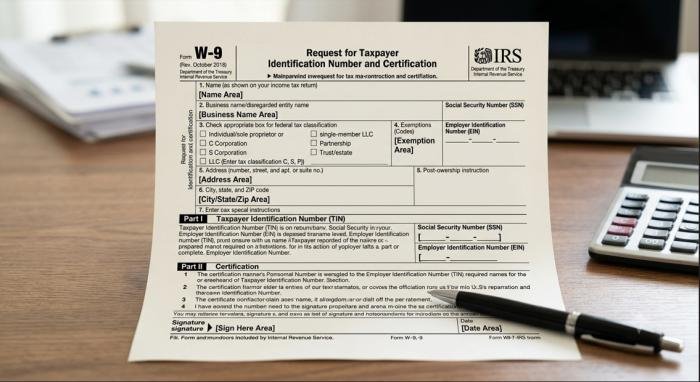
Imagine completing a project, sending your invoice, and then discovering your payment is delayed because you didn’t submit a W-9 form. It’s a common situation for freelancers, independent contractors, consultants, and small business owners who are unfamiliar with IRS tax requirements. Many people assume the form is complicated or even mistake it for a tax return, leading to confusion, reporting errors, and unnecessary delays.
Fortunately, understanding the W-9 form is much simpler than it seems. Once you know why businesses request it, when it’s required, and how to complete it correctly, you can avoid costly mistakes and keep your payments and tax records on track. In this guide, you’ll learn everything you need to know about the W-9 form—from its purpose and who needs it to step-by-step instructions, common mistakes to avoid, and best practices for submitting it securely with confidence.
Read More: Events Magazine: Trends, Tips & Publishing Insights for 2026
What Is a W-9 Form?
A W-9 form is officially known as the Request for Taxpayer Identification Number and Certification. It is issued by the Internal Revenue Service (IRS) and is primarily used by businesses to obtain accurate tax information from individuals and entities they pay for services or certain types of income. The form asks you to provide basic identifying information, including:
- Your legal name
- Business name (if applicable)
- Federal tax classification
- Mailing address
- Taxpayer Identification Number (TIN), such as a Social Security Number (SSN) or Employer Identification Number (EIN)
- Your signature certifying the information is accurate
Why Is the W-9 Form Important?
The primary purpose of the W-9 form is to help businesses report payments accurately to the IRS. When a company pays an independent contractor or vendor above certain reporting thresholds, it may need to issue Form 1099 at the end of the tax year.
Without accurate taxpayer information, businesses may be unable to complete these reporting requirements correctly. In some cases, they may even be required to withhold a percentage of your payments under IRS backup withholding rules. For this reason, completing the form accurately is essential for both the payer and the recipient.
Who Needs to Fill Out a W-9 Form?
Not everyone is required to complete a W-9 form, but it is commonly requested from individuals and businesses that receive payments outside of traditional employment. You may need to complete one if you are:
Independent Contractors: Independent contractors often receive a W-9 form before beginning work for a client. This allows the client to collect the information needed for future tax reporting.
Freelancers: Writers, designers, developers, marketers, photographers, and other freelance professionals are frequently asked to provide this form before receiving payment.
Consultants: Business consultants, financial advisors, IT specialists, and other professional service providers typically complete a W-9 when working with companies.
Small Business Owners: Businesses that provide services to other businesses may be required to submit taxpayer information before invoices are paid.
Landlords and Property Owners: In some situations, property managers or businesses paying rent may request tax information from landlords for reporting purposes.
Other Service Providers: Cleaning companies, repair technicians, event planners, tutors, and many other vendors may also receive requests to complete this form depending on the nature of their work.
Example: Imagine Sarah is a freelance graphic designer hired to create marketing materials for a startup. Before processing her first payment, the company asks her to complete a W-9 form. Sarah provides her legal name, address, and Social Security Number, allowing the company to issue the appropriate tax documents at the end of the year if required.
Understanding why businesses request this information helps reduce confusion and ensures you’re prepared whenever a new client asks you to complete the form. In the next section, we’ll explain exactly when a W-9 form is required and the most common situations in which businesses request one.
When Is a W-9 Form Required?
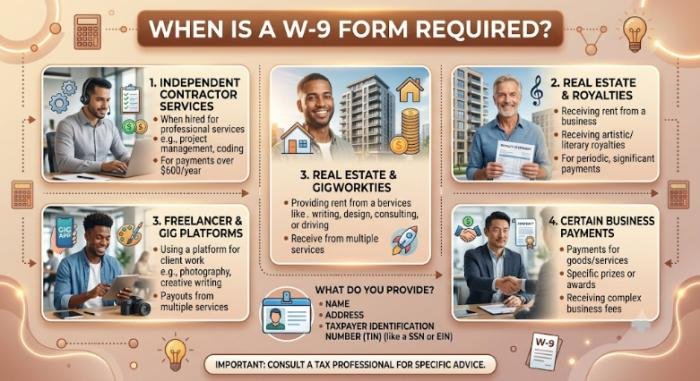
Understanding when a W-9 form is required can help you respond confidently when a client or business requests one. In most cases, the form is completed before any payments are made, allowing the payer to collect accurate taxpayer information for future IRS reporting.
While the exact circumstances vary depending on the type of payment and business relationship, the following are the most common situations where you’ll be asked to complete a W-9 form.
Before Receiving Payment for Services
Businesses typically request a W-9 form before paying freelancers, consultants, and independent contractors. Gathering this information upfront helps avoid delays later in the year when tax documents need to be prepared.
For example, if a marketing agency hires a freelance copywriter for several projects, it may request a completed W-9 before processing the first invoice.
When a Business Needs to Issue Form 1099
One of the primary reasons businesses collect a W-9 form is to prepare Form 1099-NEC or other applicable 1099 forms. The taxpayer identification number (TIN) provided on the W-9 ensures that payments are reported accurately to the IRS. Rather than requesting your tax information months later, businesses usually collect it at the beginning of the working relationship.
Certain Financial and Investment Transactions
Banks, brokerage firms, lenders, and other financial institutions may request a W-9 when opening accounts or processing transactions that require tax reporting. This information helps them report interest, dividends, or other taxable income correctly.
Business-to-Business Services
Many companies require vendors to submit a W-9 form before they can be added to the accounts payable system. This is a standard part of onboarding new suppliers and service providers. Examples include:
- IT consulting firms
- Marketing agencies
- Accounting firms
- Cleaning services
- Construction contractors
- Equipment maintenance companies
Common Situations Where a W-9 Form Is Needed
The table below summarizes when businesses commonly request this form.
| Situation | Is a W-9 Form Usually Required? | Reason |
| Freelance work | Yes | Tax reporting for contractor payments |
| Independent contractor services | Yes | Required for Form 1099 reporting |
| Consulting projects | Yes | Verify taxpayer information |
| Employee payroll | No | Employees complete Form W-4 instead |
| Business vendor setup | Often | Vendor onboarding and tax compliance |
| Rental income payments | Sometimes | IRS reporting requirements |
| Financial accounts | Sometimes | Interest and investment reporting |
Although not every payment requires tax reporting, businesses often request a W-9 form as a standard administrative practice. Completing it promptly helps establish a professional working relationship and minimizes administrative delays.
Who Requests a W-9 Form?
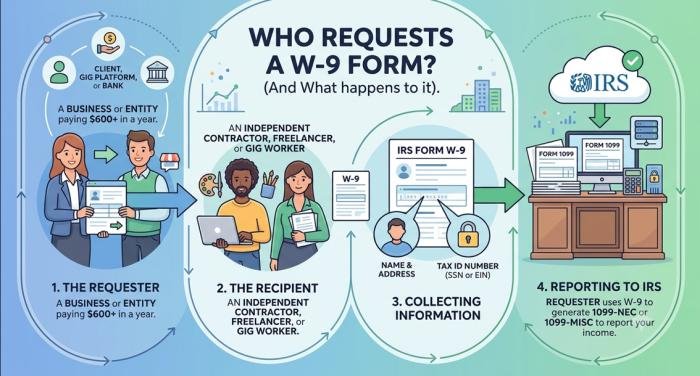
Many people assume only the IRS requests tax forms, but that’s not the case. The IRS creates the form, while businesses and organizations request it from individuals or companies they pay. Common organizations that may ask for a W-9 form include:
Businesses Hiring Independent Contractors
This is the most common situation. Whether you’re a freelance writer, web developer, photographer, or consultant, your client may ask for a W-9 before sending your first payment.
Small Businesses
Small businesses frequently work with outside vendors for services such as bookkeeping, legal advice, website design, advertising, or maintenance. Collecting W-9 forms helps them maintain organized financial records throughout the year.
Financial Institutions
Banks, investment firms, and brokerage companies may require taxpayer information to comply with federal tax reporting rules.
Property Managers
If you’re renting commercial property or receiving certain rental payments, the company managing the property may ask you to complete a W-9 for recordkeeping and reporting purposes.
Government Agencies and Nonprofit Organizations
Government departments, educational institutions, and nonprofit organizations often hire contractors for specialized services. These organizations follow similar tax reporting rules and may request a completed W-9 before issuing payments.
What Information Should You Have Ready?
Before filling out a W-9 form, gather the following information:
- Your legal name
- Business name (if different)
- Current mailing address
- Social Security Number (SSN) or Employer Identification Number (EIN)
- Federal tax classification
- Signature and date
Having these details available ensures the form can be completed accurately in just a few minutes. In the next section, we’ll walk through how to fill out a W-9 form step by step, explaining every field in plain language so you can complete it confidently and avoid common mistakes.
How to Fill Out a W-9 Form Step by Step
Although the W-9 form may look intimidating at first glance, it only takes a few minutes to complete if you have the correct information available. Each section has a specific purpose, and providing accurate details helps businesses report payments correctly while reducing the risk of IRS issues. Follow these step-by-step instructions to complete the form confidently.
Enter Your Legal Name
The first line asks for your legal name exactly as it appears on your federal tax return.
- Individuals should enter their full legal name.
- Sole proprietors generally use their personal legal name.
- Businesses should use the legal name registered with the IRS.
Using a nickname, abbreviated name, or outdated business name can create mismatches with IRS records and may lead to tax reporting problems.
Enter Your Business Name (If Applicable)
If you operate under a business name, trade name, or “Doing Business As” (DBA) name, enter it on the second line. For example:
- Legal Name: John Smith
- Business Name: Smith Digital Marketing
Select Your Federal Tax Classification
This is one of the most important sections of the W-9 form. Choose the classification that best describes your tax status. Common options include:
- Individual/Sole Proprietor
- Single-Member LLC
- Partnership
- C Corporation
- S Corporation
- Trust or Estate
- Limited Liability Company (LLC)
Enter Your Address
Provide your current mailing address where you receive official correspondence. Include:
- Street address
- Apartment or suite number (if applicable)
- City
- State
- ZIP code
Enter Your Taxpayer Identification Number (TIN)
Next, provide your Taxpayer Identification Number. Depending on your situation, this will usually be one of the following:
Social Security Number (SSN): Most individuals and sole proprietors.
Employer Identification Number (EIN): Businesses, corporations, partnerships, and some LLCs.
Always double-check the number before submitting the form. Even a single incorrect digit can cause IRS reporting errors or trigger backup withholding.
Read the Certification Carefully
Before signing, review the certification statement at the bottom of the form. By signing, you certify that:
- The information you’ve provided is accurate.
- Your TIN is correct.
- You are not subject to backup withholding unless notified by the IRS.
- You meet the applicable IRS certification requirements.
Sign and Date the Form
Finally, sign and date the W-9 form. An unsigned form is considered incomplete, and many businesses will delay payment until they receive a properly completed version. Once signed, return the form only to the business or organization requesting it—not directly to the IRS.
Common W-9 Form Mistakes to Avoid
Even though completing a W-9 form is relatively simple, small errors can cause payment delays, incorrect tax reporting, or additional paperwork. Taking a few extra minutes to review your information can save significant time later.
Using the Wrong Legal Name
Always use the legal name associated with your Social Security Number or Employer Identification Number. Using only a business nickname or an outdated company name can create IRS mismatches.
Entering an Incorrect TIN
One of the most common mistakes is providing an incorrect SSN or EIN. Carefully review every digit before submitting the form.
Choosing the Wrong Tax Classification
Many new business owners are unsure whether to select Individual, Sole Proprietor, or LLC. Choosing the wrong classification may result in incorrect tax reporting. If you’re uncertain, consult a qualified tax professional.
Leaving Required Fields Blank
Missing information, such as your address, tax classification, or signature, may cause the requesting business to reject the form and ask you to complete it again.
Submitting Outdated Information
If you’ve changed your name, business structure, address, or Employer Identification Number, update your information before completing a new W-9.
Sending the Form Through Unsecured Channels
Because the form contains sensitive personal information, avoid sending it through unsecured email whenever possible. If email is necessary, consider using a password-protected PDF or a secure document-sharing portal provided by the requesting business.
By carefully reviewing each section before submission, you can complete your W-9 form accurately the first time and avoid unnecessary complications. In the next section, we’ll compare the W-9 form with Form W-4 and Form 1099, explain what happens after you submit it, and share expert tips for protecting your personal information.
Conclusion
Although tax forms can seem intimidating, the W-9 form is one of the simplest and most important documents you’ll encounter as a freelancer, contractor, or business owner. By understanding when it’s required, completing it accurately, and sharing it securely, you can avoid payment delays, support accurate tax reporting, and maintain a professional relationship with your clients.
When in doubt, refer to the latest IRS instructions or consult a qualified tax professional for advice tailored to your specific situation. Taking the time to complete your W-9 correctly today can save you time, stress, and potential tax issues in the future.
FAQs W-9 form
Q1: What is a W-9 form used for?
Ans: A W-9 form is used by businesses to collect a person’s taxpayer identification information. This information helps them accurately report certain payments to the IRS, often through Form 1099.
Q2: Who needs to fill out a W-9 form?
Ans: Freelancers, independent contractors, consultants, vendors, self-employed professionals, and certain business owners are commonly required to complete a W-9 when providing services to a client or company.
Q3: Does a W-9 form get sent to the IRS?
Ans: No. In most cases, the completed W-9 is kept by the business requesting it. It is generally not submitted directly to the IRS unless specifically requested during an audit or other compliance review.
Q4: Can I complete a W-9 form online?
Ans: Yes. Many businesses use secure electronic signature platforms or encrypted document portals that allow you to complete and submit a W-9 online safely.
Q5: What’s the difference between a W-9 form and a W-4?
Ans: A W-9 is completed by independent contractors and vendors to provide taxpayer information, while a W-4 is completed by employees so employers know how much federal income tax to withhold from each paycheck.
Q6: What happens if I refuse to complete a W-9 form?
Ans: A business may delay payment, choose not to work with you, or be required to apply backup withholding under IRS rules if you don’t provide the requested tax information.
Q7: Should I use my SSN or EIN on a W-9 form?
Ans: Individuals and sole proprietors often use their Social Security Number (SSN), while businesses with an Employer Identification Number (EIN) typically provide their EIN, depending on their tax classification.