
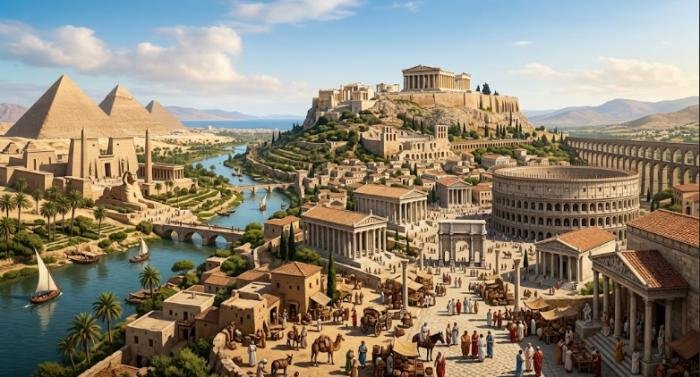
The story of ancient civilizations begins with people transforming small settlements into increasingly complex societies. Over thousands of years, communities developed agriculture, organized governments, trade networks, writing systems, religious traditions, and cities that became centers of political and cultural life.
There was no single birthplace of civilization. Complex societies emerged independently in different regions, including Mesopotamia, Egypt, South Asia, China, Mesoamerica, and the Andes. Each developed according to its own geography, resources, traditions, and historical circumstances.
Read More: What Is Wet Shaving? How It Works for Beginners
What Are Ancient Civilizations?
Ancient civilizations were complex societies with organized systems of government, agriculture, trade, religion, labor, and culture. Many developed permanent settlements, specialized occupations, social divisions, administrative institutions, and methods of recording information. However, civilization should not be viewed as a simple measure of how “advanced” a society was. Different communities developed different solutions to their environments. One society might excel in water management, another in astronomy, another in architecture, and another in long-distance trade. The development of civilization was also gradual. Agriculture appeared before many cities, villages preceded large urban centers, and states developed through long processes of political and economic change.
When Did the First Civilizations Begin?
There is no single worldwide date for the beginning of civilization. Some of the earliest known urban societies developed in Mesopotamia during the fourth millennium BCE. Ancient Egypt became a unified state around the beginning of the third millennium BCE,
While large urban centers of the Indus civilization flourished during the third millennium Other complex societies developed independently at different times in China, the Mediterranean, Mesoamerica, and the Andes.
Why Did Ancient Civilizations Develop?
Several factors contributed to the development of complex societies.
Agriculture and Food Production
Agriculture provided a more dependable food supply in many regions. When communities produced sufficient food to support people beyond farming, specialized occupations became possible. Builders, craftspeople, merchants, soldiers, administrators, and religious specialists could contribute to society while relying on agricultural production from others.
Rivers and Natural Resources
Rivers played a major role in several early societies. The Tigris and Euphrates supported agriculture in Mesopotamia, while the Nile provided fertile land and transportation in Egypt. The Indus river system supported extensive settlement in South Asia. Rivers were valuable, but they were not the only reason civilizations developed. Effective management of land, water, labor, resources, and trade was equally important.
Trade and Cultural Exchange
Ancient communities often needed resources that were unavailable locally. Trade connected settlements and allowed goods such as metals, stone, timber, textiles, and luxury items to travel across large distances. Trade also carried ideas, technologies, artistic traditions, and cultural practices between societies.
Mesopotamian Civilizations
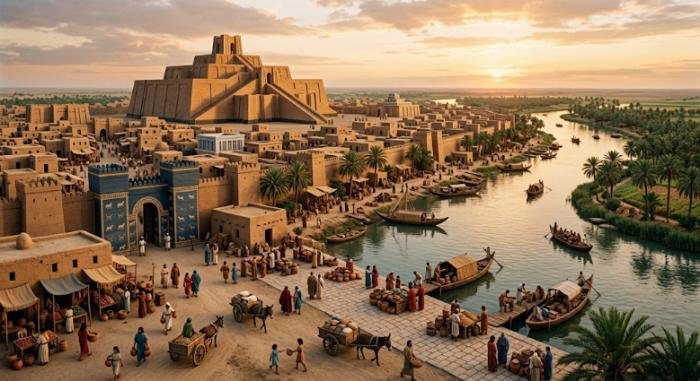
Mesopotamia, located between the Tigris and Euphrates rivers, became one of the world’s earliest major centers of urban civilization. Sumerian cities such as Uruk and Ur developed into important centers of administration, religion, crafts, and commerce.
Sumer and the Development of Writing
Uruk is particularly important because archaeological evidence shows early urban growth and administrative activity there. Mesopotamians developed cuneiform, one of the earliest known writing systems. Early cuneiform was strongly associated with record keeping, including economic and administrative information. Over time, it was used for laws, literature, religious texts, correspondence, and other purposes.
Babylon and Ancient Law
Mesopotamian history later included the rise of Babylon and the expansion of other powerful states. The Laws of Hammurabi are among the best-known surviving legal collections from the ancient world. They address subjects such as property, trade, family relationships, labor, and penalties.
Ancient Egyptian Civilization
Ancient Egypt developed along the Nile and maintained a remarkable political and cultural tradition for thousands of years. The Nile supported agriculture, transportation, settlement, and economic activity.
Its fertile valley stood in sharp contrast to the surrounding desert, helping create a concentrated population.
Pharaohs and Government
The pharaoh occupied a central position in Egypt’s political and religious system. But governing Egypt required far more than a king. Officials, scribes, priests, farmers, soldiers, artisans, and laborers all played important roles. Scribes recorded administrative information, economic transactions, religious texts, and other material necessary for managing the kingdom.
Pyramids and Monumental Architecture
Egyptian pyramids are among the most recognizable structures of antiquity. The Giza pyramid complex forms part of the broader Memphis and its Necropolis World Heritage site. The construction of such monuments required sophisticated planning, surveying, transportation, material supply, and labor organization. They were also part of larger religious and funerary complexes rather than isolated structures.
Religion and the Afterlife
Religion was deeply connected with Egyptian society. Temples, tombs, religious texts, funerary objects, and mummification reflected beliefs concerning death and the afterlife. Egyptians also developed hieroglyphic writing and applied mathematical knowledge to surveying, construction, and administration.
The Indus Valley Civilization
The Indus or Harappan civilization developed across parts of present-day Pakistan and northwestern India. Major cities included Harappa and Mohenjo-daro. Mohenjo-daro is especially significant for its sophisticated urban planning.
UNESCO identifies organized streets, drainage systems, wells, soak pits, baked-brick structures, and public buildings among the site’s major archaeological features.
Urban Planning and Water Management
The city’s infrastructure demonstrates that ancient South Asian communities possessed advanced knowledge of construction, sanitation, and water management. Craft production and trade were also important. Archaeologists have found pottery, beads, seals, tools, and other objects that demonstrate specialized production and connections between different settlements.
The Unread Indus Script
The Indus civilization presents an unusual challenge because its inscriptions have not been securely deciphered. Consequently, researchers rely heavily on archaeological evidence rather than readable historical texts. This demonstrates why studying ancient civilizations requires multiple forms of evidence, including architecture, artifacts, settlement patterns, environmental data, and inscriptions.
Ancient Chinese Civilizations
Ancient China developed through several distinct societies and political periods rather than emerging as one unchanged civilization. Early complex communities formed in different parts of East Asia, with the Yellow River region becoming especially important to the development of early states.
The Shang dynasty provides some of the earliest substantial written evidence from ancient China. Archaeological discoveries reveal sophisticated bronze production, fortified settlements, royal tombs, ritual objects, and early forms of Chinese writing.
Bronze Technology and Political Power
Bronze vessels were often connected with ceremonies and elite status. Their production required access to raw materials, skilled craftspeople, and organized labor.Oracle-bone inscriptions provide evidence about royal concerns, warfare, agriculture, weather, rituals, and other subjects. These records are particularly valuable because they offer direct evidence of early Chinese writing and political culture.
Ancient Greek Civilization
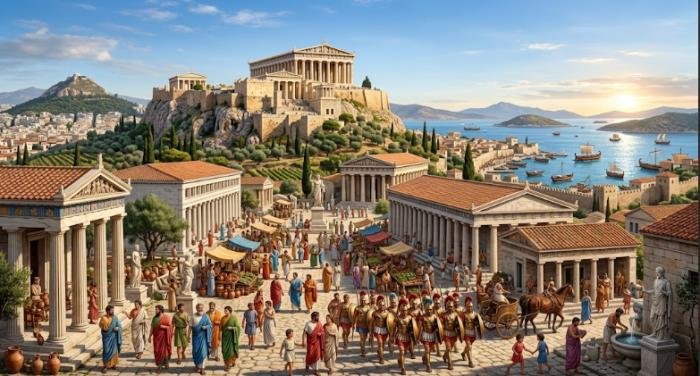
Ancient Greece was not a single unified country. It consisted of many independent communities, including city-states such as Athens and Sparta. Greek civilization developed around the Aegean and Mediterranean and became influential in philosophy, politics, literature, mathematics, science, architecture, and art.
Athens and Democracy
Athens developed a form of direct democracy in which eligible male citizens could participate in political decisions. However, this system was far from modern democracy. Women, enslaved people, and many residents without citizenship were excluded from political participation. Even with these limitations, Athenian political institutions became highly influential in later political thought.
Philosophy, Science, and the Arts
Greek thinkers such as Socrates, Plato, and Aristotle shaped philosophical traditions that continue to influence education and political theory. Greek mathematicians and scientists also developed important approaches to geometry, astronomy, medicine, and natural philosophy. Greek architecture and sculpture established styles that were later adopted and adapted by Roman and European societies.
The Hellenistic World
The conquests of Alexander the Great created a large political sphere stretching from Greece toward Egypt, Persia, Central Asia, and parts of South Asia. After Alexander’s death, successor kingdoms became important centers of cultural exchange. Greek traditions interacted with Egyptian, Persian, Central Asian, and other cultures.
Ancient Roman Civilization
Rome began as a city-state and eventually developed into one of the largest political systems of the ancient Mediterranean. Its history is commonly divided into the Roman Kingdom, Roman Republic, and Roman Empire, although the transition between these periods involved complex political changes.
The Roman Republic
During the Republic, political authority was distributed among elected officials, assemblies, and the Senate. Roman citizenship became an important institution, although citizenship rights differed across periods and populations. Rome’s expansion was supported by military organization, alliances, political institutions, and infrastructure.
Roman Engineering and Cities
Roman engineers became renowned for roads, bridges, aqueducts, public baths, amphitheaters, temples, and other structures. Aqueducts transported water to cities, while roads helped connect distant territories and support military and commercial movement.
Law and Cultural Influence
Roman law influenced later European legal traditions, although modern legal systems cannot simply be equated with ancient Roman law. Latin became a major language of administration and scholarship in western Europe and contributed substantially to several modern languages. Roman culture itself was also heavily influenced by earlier Greek and Mediterranean traditions, demonstrating that ancient societies frequently borrowed and adapted ideas.
Maya Civilization
The Maya developed a sophisticated civilization across parts of present-day Mexico, Guatemala, Belize, Honduras, and El Salvador. Rather than forming one centralized empire, Maya political life often consisted of independent or competing city-states.
Maya Cities and Architecture
Important Maya centers included Tikal, Palenque, Copán, and Calakmul. These cities contained monumental temples, plazas, palaces, pyramids, carved monuments, and other structures. UNESCO identifies Copán as an important Maya political, civil, and religious center and highlights Maya achievements in astronomy, mathematics, writing, architecture, and urban development.
Writing, Mathematics, and Astronomy
Maya scribes developed a sophisticated hieroglyphic writing system. Inscriptions record rulers, political events, religious activities, and dates. Maya scholars also developed advanced mathematical and calendrical systems. Their astronomical observations were connected with religious practices, political authority, and the measurement of time.
Civilizations of the Ancient Andes
The Andes produced several complex societies long before the rise of the Inca Empire. One important early example is Caral, a large ceremonial and urban center in present-day Peru. Later societies included the Moche, Nazca, Tiwanaku, Wari, and eventually the Inca.
Adapting to Difficult Environments
Andean societies developed agricultural and engineering techniques suited to mountains, deserts, and coastal environments. They constructed terraces, irrigation systems, roads, ceremonial structures, and administrative centers. The Inca later created an enormous state connected by an extensive road network and administrative system. Although often discussed alongside ancient civilizations, the Inca Empire was much later than the earliest civilizations of Mesopotamia and Egypt.
Ancient Cities and Urban Life
Cities transformed how people lived and worked. Urban centers concentrated political authority, religious institutions, markets, workshops, storage facilities, and administrative offices.
What Made an Ancient City Important?
An important ancient city could serve several purposes at once:
- Political administration
- Religious ceremonies
- Trade and markets
- Craft production
- Military organization
- Food distribution
- Cultural activities
Cities such as Rome, Athens, Babylon, Mohenjo-daro, and Maya centers demonstrate that urban development took many different forms.
Daily Life
Most people in ancient societies were not rulers or famous scholars. They were farmers, craftspeople, traders, soldiers, builders, servants, parents, and children.Daily life depended strongly on social status, occupation, geography, gender, and legal position. Food generally came from local agriculture, fishing, hunting, and trade. Homes ranged from modest rural structures to large urban residences. Clothing depended on climate, available materials, occupation, and social position.
Government, Law, and Social Organization
Political systems varied greatly across ancient societies. Some communities were city-states, while others were kingdoms or empires.
Kings, Emperors, and Political Institutions
Rulers often relied on administrators, soldiers, priests, tax collectors, scribes, and local officials. In Egypt, the pharaoh stood at the center of a powerful state. In Rome, political institutions changed significantly from Republic to Empire. Greek city-states developed different political systems, including democracy, oligarchy, and other forms of government.
Social Classes and Inequality
Ancient societies generally contained significant social differences. Elites controlled large amounts of wealth and political authority, while farmers, workers, craftspeople, and servants formed much larger sections of the population. Enslavement also existed in many ancient societies, but its legal status and social role varied considerably. It is therefore inaccurate to describe slavery as identical across all ancient cultures.
Religion and Belief
Religion influenced politics, art, architecture, family life, and public ceremonies throughout many ancient civilizations. Temples could function as religious centers while also controlling land, goods, labor, and administrative activities. Egyptian beliefs strongly influenced tombs and funerary traditions. Greek and Roman societies maintained extensive pantheons and rituals.
Maya religion was closely connected with rulers, calendars, astronomy, and ceremonial architecture. These traditions were not static. Religious beliefs changed as societies interacted, conquered neighboring territories, and developed new political institutions.
Writing, Science, Technology, and Innovation
One of the most important achievements of ancient civilizations was the development of systems for recording and transmitting knowledge. Writing allowed societies to preserve information about trade, government, religion, laws, and daily activities. Mesopotamians developed cuneiform, while Egyptians used hieroglyphic writing. Ancient Chinese writing can be traced through early inscriptions, and Maya scribes created an advanced hieroglyphic system.
The Indus civilization also used symbols, although its script has not been reliably deciphered. Ancient societies also made important advances in mathematics and astronomy. Mesopotamian scholars used a base-60 numerical system, while Maya mathematicians developed sophisticated numerical and calendrical methods. Egyptians applied mathematics to construction, surveying, and administration.
Trade and Cultural Exchange
Ancient societies were connected through trade routes that moved goods and ideas across long distances. Merchants exchanged metals, textiles, ceramics, food products, timber, precious stones, and luxury goods. Trade also encouraged cultural exchange.Technologies, artistic styles, religious practices, and agricultural knowledge could spread between communities.Mesopotamia, for example, became an important crossroads between different regions of the ancient Near East. Later Mediterranean, Central Asian, and Indian Ocean networks connected even wider areas. This evidence challenges the idea that ancient societies existed in complete isolation.
Why Did Ancient Civilizations Decline?
The decline of a civilization rarely had one simple cause. Political instability, warfare, environmental changes, economic problems, disease, migration, and changing trade routes could all contribute to major transformations. A drought could reduce agricultural production, create food shortages, increase political tension, and disrupt trade at the same time. Similarly, warfare could weaken governments while encouraging migration and economic disruption.
It is also important to remember that political collapse does not necessarily mean cultural disappearance. Cities may decline while populations move elsewhere, and governments can disappear while languages, traditions, technologies, and religious practices continue.
How Do We Know About Ancient Civilizations?
Historians combine several forms of evidence. Archaeologists study buildings, pottery, tools, burials, inscriptions, food remains, roads, and environmental evidence. Written records can provide information about rulers, laws, trade, religion, and social organization. Modern scientific methods such as radiocarbon dating, isotope analysis, ancient DNA research, and remote sensing can provide additional information about chronology, migration, diet, disease, and settlement patterns.
Because evidence is incomplete, historians must distinguish established facts from interpretations and unresolved questions.
Why Are Ancient Civilizations Still Important?
The influence of ancient societies remains visible in modern architecture, mathematics, law, literature, political thought, engineering, languages, and cultural heritage. Sites such as the pyramids of Egypt, Babylon, Mohenjo-daro, Roman monuments, and Maya cities provide physical evidence of societies that developed sophisticated institutions and technologies. The most important lesson is not that one civilization was the “greatest.” Instead, the history of ancient civilizations shows that people in different environments developed creative solutions to common challenges involving food, water, communication, government, trade, belief, and survival.
Conclusion
The story of ancient civilizations is not simply a collection of ruins and forgotten kingdoms. It is the history of how different societies organized themselves, adapted to their environments, exchanged ideas, developed technologies, and created cultural traditions that influenced later generations.
From Mesopotamian writing and Egyptian monuments to Indus urban planning, Chinese traditions, Greek philosophy, Roman engineering, Maya mathematics, and Andean agriculture, ancient societies left a diverse and lasting heritage.
Studying their achievements and challenges provides a broader perspective on human creativity, social organization, and cultural change. Their legacy continues to shape how people understand cities, government, science, architecture, and civilization itself.
Frequently Asked Questions
Q1: What were the first ancient civilizations?
Ans: Some of the earliest known urban civilizations developed in Mesopotamia and Egypt, followed by major civilizations in South Asia and other regions.
Q2: Why did ancient civilizations develop near rivers?
Ans: Rivers provided water, fertile land, transportation, and opportunities for agriculture, although geography alone did not determine the development of civilization.
Q3: Why did ancient civilizations decline?
Ans: Decline could result from combinations of warfare, political instability, environmental changes, economic disruption, disease, migration, and changing trade networks.
Q4: Did ancient civilizations disappear completely?
Ans: Not usually. Political states could collapse while populations, traditions, languages, and cultural practices continued in new forms.
Q5: Why should we study ancient civilizations today?
Ans: They provide valuable evidence about the development of cities, governments, technology, trade, religion, and culture, helping place the modern world within a much longer human history.
