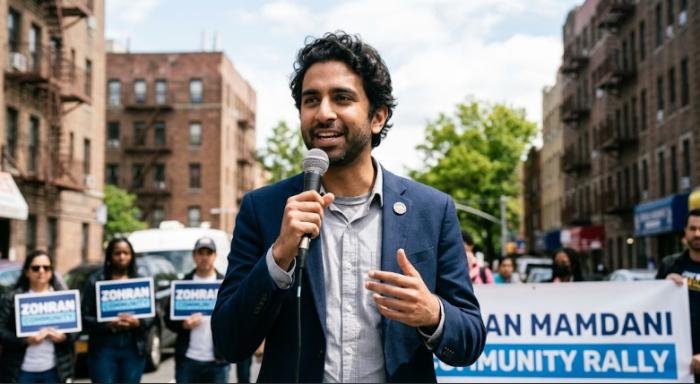
Zohran Mamdani is an American politician who became the 112th Mayor of New York City on January 1, 2026, after previously serving in the New York State Assembly. His political rise has attracted national attention because of his progressive economic agenda, emphasis on affordability, and identification with democratic socialism.
Before entering City Hall, Mamdani represented New York’s 36th Assembly District, covering parts of Queens, including Astoria and Long Island City. He first won the seat in 2020 and was reelected in 2022 and 2024. His background also includes work as a foreclosure-prevention housing counselor and political campaign organizer.
Today, zohran mamdani is best understood not simply through his campaign promises but through the policies and programs his administration has begun pursuing in New York City. This article covers his background, political career, ideology, major policy positions, and documented actions as mayor.
Read More: Ancient Civilizations: History, Culture, Cities & Lasting Legacy
Who Is Zohran Mamdani?
Zohran Kwame Mamdani is a Democratic politician and democratic socialist who has served as New York City’s mayor since January 2026. He previously served from 2021 through 2025 in the New York State Assembly, representing the 36th District in Queens.
His political identity is closely associated with affordability issues, including housing, transportation, childcare, food costs, and wages. During his Assembly career and mayoral campaign, he built a profile around policies intended to reduce living costs for working- and middle-class New Yorkers.
Mamdani’s transition to City Hall was historically significant. Bowdoin College reported that he became the city’s first mayor of South Asian descent, its first Muslim mayor, and the youngest leader of America’s largest city in more than a century.
Zohran Mamdani at a Glance
| Category | Information |
| Full name | Zohran Kwame Mamdani |
| Current office | Mayor of New York City |
| Took office | January 1, 2026 |
| Previous office | New York State Assembly, 36th District |
| Political party | Democratic Party |
| Political identification | Democratic socialist |
| College | Bowdoin College |
| Field of study | Africana Studies |
| Previous work | Housing counselor and political organizer |
Zohran Mamdani’s Early Life and Background
Mamdani was born in Kampala, Uganda, and moved to New York City with his family when he was seven. Columbia University’s South Asia Institute has described him as a graduate of the Bronx High School of Science who later earned a bachelor’s degree in Africana Studies from Bowdoin College.
His family background also helped shape his exposure to politics, culture, and international affairs. His father, Mahmood Mamdani, is an academic specializing in African history and politics and has served as a professor at Columbia University. His mother is filmmaker Mira Nair.
At Bowdoin, Mamdani studied Africana Studies and was involved with student media. After graduating in 2014, he worked as a foreclosure-prevention housing counselor in Queens. That experience placed him in direct contact with New Yorkers dealing with housing insecurity and financial pressure, issues that later became central to his political work.
Education and Early Professional Work
Mamdani’s educational background is notable because it combined the study of African history and culture with later practical work in housing and community organizing.
After college, he worked as a housing counselor helping homeowners facing foreclosure. He also became involved in political campaigns and community organizing before seeking elected office.
These experiences provide useful context for his later emphasis on housing affordability and economic security. Rather than beginning his public career as a conventional citywide politician, he developed his political profile through local campaigns, organizing, and constituency-focused work.
Zohran Mamdani’s Political Career
Entry Into New York Politics
Mamdani became increasingly active in New York City politics during the 2010s. His political involvement included campaign work and organizing before he sought elected office himself.He later became associated with the Democratic Socialists of America and developed a political identity focused on economic inequality, housing, labor rights, and public services. Wikipedia’s biographical record notes that he worked on political campaigns before winning his own Assembly seat in 2020.
New York State Assembly Career
Mamdani announced his campaign for the 36th Assembly District in 2019. In the 2020 Democratic primary, he defeated incumbent Assemblymember Aravella Simotas and subsequently won the general election.He represented the district from January 2021 through December 2025 and was reelected in 2022 and 2024.
During his Assembly tenure, his constituent work included housing assistance, public benefits, transportation concerns, and other community services. His 2024 Assembly newsletter, for example, highlighted work involving public transit, education funding, asylum-seeker services, and constituent assistance involving landlords and government benefits.
From Assemblymember to Mayoral Candidate
Mamdani announced his campaign for New York City mayor in October 2024. His campaign centered heavily on affordability and proposed policies addressing housing, childcare, transportation, food prices, and wages.
His Democratic primary victory in June 2025 became a major turning point. According to the New York City Board of Elections, Mamdani received 573,169 votes in the final ranked-choice round, defeating former Governor Andrew Cuomo, who received 443,229.
He then won the November 2025 general election and took office on January 1, 2026. Bowdoin College reported that he received more than one million votes in the general election and became the city’s youngest mayor in more than a century.
What Political Ideology Does Zohran Mamdani Follow?
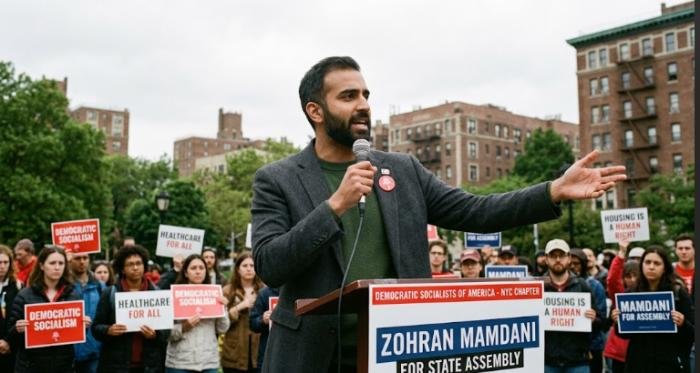
Mamdani identifies as a democratic socialist and has been associated with the New York City chapter of the Democratic Socialists of America. His political agenda emphasizes reducing economic inequality and using public institutions to make basic necessities more affordable.
His approach generally places affordability at the center of policy. Instead of treating housing, transportation, childcare, and food as separate issues, his political platform connects them to the broader cost of living.
That philosophy helps explain why his agenda has included proposals such as expanded affordable housing, free or lower-cost public transportation, universal childcare, municipal grocery stores, stronger tenant protections, and higher wages.
At the same time, his approach has generated debate about taxation, government spending, business conditions, and the practical cost of implementing ambitious social programs.
Zohran Mamdani’s Housing Policies
Housing has been one of the most important themes in Mamdani’s political career.During his campaign, he advocated for expanding affordable housing, protecting tenants, and addressing rent burdens. As mayor, his administration has continued to place housing near the center of its agenda.
In July 2026, the Mayor’s Office announced a housing enforcement initiative called the “Rental Ripoff Report.” The administration said it would pursue 23 policy changes involving tenant protections, landlord enforcement, housing-code enforcement, rental fees, utility charges, and disclosure of AI-altered rental listings.
The administration has also emphasized large-scale housing construction and preservation. Its approach reflects Mamdani’s broader argument that New York’s affordability problem cannot be addressed solely through individual assistance; the city also needs more housing and stronger tenant protections.
Rent and Tenant Protection
Mamdani’s political platform has supported stronger protections for renters, particularly people living in rent-stabilized apartments.His administration has subsequently focused on enforcement against negligent landlords and hazardous housing conditions. That distinction matters: campaign proposals describe what Mamdani wanted to accomplish, while mayoral announcements document measures his administration has actually begun pursuing.
Zohran Mamdani on Public Transportation
Transportation affordability has also been central to Mamdani’s political message.
His campaign supported fare-free city bus service, reflecting his view that transportation costs contribute directly to the cost of living. His broader transportation agenda has also emphasized improving bus service and making public transit more accessible.
As mayor, his administration has continued to pursue bus-focused improvements. These initiatives should be evaluated separately from the broader campaign promise of completely fare-free buses, because an announced goal and an implemented citywide policy are not necessarily the same thing.
His transportation philosophy is closely connected to his economic agenda: reducing commuting costs can increase disposable income for people who rely on public transportation.
Zohran Mamdani’s Childcare Policies
Childcare has been another major part of Mamdani’s affordability agenda.His campaign supported universal childcare, arguing that high childcare costs can make it difficult for families to remain in New York City and for parents to participate fully in the workforce.
His administration has already taken a concrete step in this direction. On August 13, 2026, the Mayor’s Office announced that the city would cover out-of-pocket childcare costs for families already receiving childcare assistance through city contracts and vouchers. The policy is expected to benefit approximately 22,000 low-income families, with the city covering the $5.2 million in annual costs those families had previously paid.
This is an important example of the difference between a broad political objective and a specific policy action: universal childcare remains a larger goal, while eliminating out-of-pocket costs for subsidized families is a defined measure that the administration has announced.
Zohran Mamdani’s Minimum Wage and Labor Views
Mamdani’s campaign supported raising New York City’s minimum wage to $30 per hour by 2030. The proposal reflects his broader belief that wages should rise alongside the cost of living.His labor agenda has also emphasized stronger protections for workers and economic policies designed to benefit people with lower and middle incomes.
The policy debate surrounding a higher minimum wage includes competing considerations. Supporters argue that higher wages could help workers cope with New York’s high living costs, while critics raise questions about effects on employers, prices, hiring, and small businesses.For an accurate article, the $30 figure should be described as a policy proposal unless and until official city or state action changes the legal minimum wage.
Zohran Mamdani and Food Affordability
Mamdani’s municipal grocery-store idea became one of the most recognizable parts of his political platform.The concept is intended to use publicly backed grocery operations to provide affordable food and create downward pressure on prices. Supporters see municipal stores as a way to address food affordability, while critics have questioned whether government-run retail can operate efficiently at scale.
In July 2026, the Mayor’s Office announced that five new municipal grocery stores would offer a core basket of groceries at prices 30% lower, including all fresh produce, meat and seafood, and roughly 20 additional categories of pantry staples, dairy, and refrigerated goods.This represents one of the clearest examples of a campaign concept moving into an operational policy under Mamdani’s administration.
Zohran Mamdani’s Economic and Tax Policies
Mamdani’s economic philosophy generally favors greater public investment funded partly through higher contributions from wealthy individuals and corporations.During his mayoral campaign, he supported raising taxes on corporations and high-income New Yorkers to help fund affordability programs.
The issue became part of his administration’s fiscal debate soon after taking office. In February 2026, the Mayor’s Office presented two broad approaches to addressing the city’s fiscal pressures: raising additional revenue from wealthy New Yorkers and profitable corporations or making reductions that would affect working- and middle-class residents.
His administration has also focused on small businesses. In August 2026, the Mayor’s Office announced more than $8.4 million in grants to support small businesses and commercial corridors across the city.
These initiatives illustrate an important feature of Mamdani’s economic approach: he combines progressive taxation and public investment with efforts intended to support neighborhood businesses.
Zohran Mamdani on LGBTQ+ Rights and Social Issues
Mamdani has supported LGBTQ+ rights, reproductive freedom, and anti-discrimination protections. His political agenda places these issues within a broader framework of equal access to government services and protection from discrimination.
His social-policy positions have contributed to his identity as a progressive Democrat and democratic socialist.
For readers evaluating his political record, it is useful to consider both his stated positions and the actions taken by his administration rather than relying solely on campaign rhetoric.
What Has Zohran Mamdani Accomplished as Mayor?
Because Mamdani has been mayor only since January 2026, his record is still developing. A responsible assessment should separate completed actions from longer-term goals.Documented actions by August 2026 include measures involving subsidized childcare, municipal grocery stores, tenant protections, small-business support, and city fiscal policy.
The childcare policy announced in August provides a particularly measurable example: approximately 22,000 families receiving childcare assistance are expected to have their out-of-pocket costs eliminated beginning in September.The municipal grocery initiative is another concrete example, with the administration announcing a 30% lower price on a specified basket of goods at five municipal grocery stores.
At the same time, some of Mamdani’s larger goals require years of construction, legislation, budgeting, or cooperation from other levels of government. It would therefore be premature to judge long-term outcomes solely from early administrative announcements.
Criticism and Political Debate Around Zohran Mamdani
Mamdani’s rise has produced strong support as well as significant criticism.Supporters point to his focus on affordability, housing, childcare, public transportation, and wages. They argue that conventional approaches have failed to address the financial pressures facing many New Yorkers.
Critics have raised concerns about the cost of his proposals, potential tax increases, the role of government in private markets, and the practical challenges involved in implementing large public programs.
The strongest analysis should acknowledge both sides without turning political arguments into established facts. For example, a campaign’s projected cost or expected benefit should not be presented as a proven outcome until reliable evidence becomes available.
His administration’s fiscal decisions will be particularly important because many of his affordability initiatives require significant public resources. The city’s budget position and its relationship with New York State will therefore remain central to the debate over his agenda.
Why Zohran Mamdani Matters in New York Politics
Mamdani’s significance extends beyond his personal biography.His election demonstrated the ability of a progressive, affordability-focused candidate to win a major American city’s mayoralty. His background as a former Assemblymember, housing counselor, organizer, and democratic socialist also gives his administration a different political profile from many recent New York City administrations.
His policy agenda puts a central question before New York City: how much should city government do to directly reduce the cost of housing, childcare, food, transportation, and other necessities?The answer will depend not only on Mamdani’s political priorities but also on budgets, legislation, agency capacity, economic conditions, and cooperation from state and federal governments.
Conclusion
Zohran Mamdani‘s political story combines community organizing, housing work, state-level legislation, and a rapid rise to the leadership of New York City. His career before City Hall helps explain why affordability has remained at the center of his political agenda.As mayor, Mamdani has moved beyond campaign messaging and begun implementing or advancing policies involving childcare, groceries, housing enforcement, transportation, and small-business support.
At the same time, many of his most ambitious goals remain long-term projects whose success will depend on funding, legislation, implementation, and measurable results. The most useful way to evaluate zohran mamdani is therefore to follow the evidence: distinguish his biography from his political ideology, campaign proposals from enacted policies, and official claims from independently verified outcomes.As his administration continues, those distinctions will be increasingly important for understanding both his political legacy and the direction of New York City.
Frequently Asked Questions About Zohran Mamdani
Q1. Who is Zohran Mamdani?
Ans: Zohran Mamdani is a Democratic politician and democratic socialist who has served as the 112th mayor of New York City since January 1, 2026. Before becoming mayor, he represented Queens’ 36th District in the New York State Assembly from 2021 through 2025.
Q2. Where was Zohran Mamdani born?
Ans: Mamdani was born in Kampala, Uganda. He moved to New York City with his family at age seven and later attended the Bronx High School of Science and Bowdoin College.
Q3. What did Zohran Mamdani do before becoming mayor?
Ans: Before becoming mayor, Mamdani served in the New York State Assembly and previously worked as a foreclosure-prevention housing counselor and political organizer. He was elected to the Assembly in 2020 and represented the 36th District through 2025.
Q4. Is Zohran Mamdani a democratic socialist?
Ans: Yes. Mamdani identifies as a democratic socialist and has been associated with the Democratic Socialists of America. His political agenda emphasizes economic equality, public investment, stronger tenant protections, and affordability programs.
Q5. What are Zohran Mamdani’s main policies?
Ans: His major policy priorities have included affordable housing, tenant protections, childcare, public transportation, food affordability, higher wages, progressive taxation, and support for working-class New Yorkers. Some were campaign proposals, while others have developed into policies or initiatives under his mayoral administration.
Q6. Does Zohran Mamdani support free public transportation?
Ans: His mayoral campaign supported fare-free city bus service. His broader transportation agenda focuses on making public transit more affordable and accessible. Specific campaign proposals should be distinguished from transportation policies that have actually been implemented.
Q7. What is Zohran Mamdani’s childcare policy?
Ans: His broader platform supports universal childcare. In August 2026, his administration announced that the city would eliminate out-of-pocket childcare costs for approximately 22,000 families already receiving childcare assistance through vouchers and contracts.
Q8. What is Zohran Mamdani’s housing policy?
Ans: His housing agenda emphasizes increasing affordable housing, protecting tenants, improving enforcement against negligent landlords, and addressing rent burdens. In July 2026, his administration announced 23 housing-policy changes through its “Rental Ripoff Report,” including stronger tenant protections and enforcement measures.
Q9. What is Zohran Mamdani’s minimum wage proposal?
Ans: During his mayoral campaign, Mamdani proposed raising New York City’s minimum wage to $30 per hour by 2030. This should be described as a policy proposal unless and until applicable legislation or official wage rules establish that rate.