

The Habsburg chin is a popular term for the distinctive lower-face appearance associated with members of the Habsburg dynasty, one of Europe’s most influential royal families. It is often discussed alongside the better-known expression “Habsburg jaw,” a historical term associated with a prominent lower facial profile.
Although portraits of Habsburg rulers clearly show recurring facial characteristics, modern research gives the subject more nuance than the popular story suggests. The appearance cannot simply be reduced to a single “Habsburg gene,” nor can every prominent chin be attributed to the dynasty. Researchers have examined historical portraits to distinguish mandibular prognathism, or forward projection of the lower jaw, from maxillary deficiency, in which the upper jaw has reduced forward projection. Studies have found evidence that both characteristics contributed to the appearance traditionally associated with the Habsburgs.
The story also intersects with the dynasty’s extensive history of marriages between relatives. A major pedigree analysis found that the inbreeding coefficient among Spanish Habsburg kings increased substantially across generations, reaching an estimated 0.254 for Charles II. However, the relationship between ancestry, inbreeding, genetics, and facial morphology is complex and should not be presented as a simple cause-and-effect story.
Read More: Quabbin Reservoir Underwater Pictures: Hidden History Beneath Water
What Is the Habsburg Chin?
The phrase Habsburg chin is not a formal modern medical diagnosis. Instead, it is a popular description of a facial characteristic historically associated with members of the Habsburg family.In many discussions, the term refers to a lower face that appears unusually prominent or projecting. The appearance may be particularly noticeable in profile, where the relationship between the upper and lower jaws is easier to see.
The more established historical expression is Habsburg jaw. Medical literature has used that term as an eponym for facial patterns involving mandibular prognathism, mandibular hyperplasia, or mandibular overgrowth. However, research examining portraits of Spanish Habsburg rulers found that maxillary deficiency could make an important contribution as well.
This distinction matters because a prominent-looking chin does not necessarily mean that the lower jaw itself is excessively large. A person may appear to have a projecting lower jaw because the upper jaw is positioned farther back than usual.
Habsburg Chin vs. Habsburg Jaw
The two expressions are often treated as synonyms in popular articles, but they are not perfectly interchangeable.Habsburg chin is primarily an informal descriptive expression. It focuses on the visible appearance of the chin or lower face.
Habsburg jaw is the more historically established eponym. In medical literature, it has been associated with mandibular prognathism and related skeletal characteristics.
Mandibular prognathism describes a forward projection of the mandible relative to the surrounding craniofacial structures. It can contribute to a Class III facial or dental relationship.
Maxillary deficiency describes insufficient forward projection of the upper jaw. Because the upper and lower jaws form a relationship, reduced projection of the maxilla can make the lower face appear more prominent.
Modern research on the Spanish Habsburgs suggests that both mandibular and maxillary characteristics deserve consideration rather than assuming that the famous appearance was caused solely by an oversized lower jaw.
Is the Habsburg Chin a Medical Condition?
Not by itself.The phrase is a historical and popular label rather than a standalone diagnosis. A clinician assessing a person’s facial structure would use anatomical and orthodontic terminology instead.
Mandibular prognathism is a recognized craniofacial characteristic, but its causes can vary. Research indicates that genetic, developmental, and environmental factors may all play roles, and the inheritance pattern can be complex.
For that reason, it would be inaccurate to examine someone’s chin and conclude that the person has a specific Habsburg-related condition.
The Habsburg Dynasty Behind the Famous Facial Feature
The Habsburgs were one of Europe’s major ruling dynasties. Their political influence extended across large parts of Europe, and different branches of the family occupied important thrones for centuries.The facial characteristic became especially associated with the Spanish Habsburgs, who ruled Spain from 1516 until 1700. This branch provides unusually rich historical material because portraits of successive rulers allow researchers to compare facial features across generations.
The Spanish Habsburg line eventually ended with Charles II of Spain, who died in 1700 without a surviving heir. A detailed genealogical study of the dynasty examined more than 3,000 individuals across a pedigree extending up to 16 generations and documented the increasing level of relatedness among successive Spanish Habsburg kings.
Why Did Habsburg Royals Marry Relatives?
Royal marriages in early modern Europe were often political as well as personal. Marriage could strengthen alliances, preserve territories, support claims to succession, and consolidate dynastic power.Within the Spanish Habsburg family, marriages between relatives occurred repeatedly. The documented relationships included first-cousin unions and uncle-niece marriages. Over multiple generations, these relationships contributed to a high degree of shared ancestry within the royal pedigree.
It is important, however, not to interpret every royal marriage as an attempt to preserve a facial trait. The principal historical motivations were dynastic and political.The genetic consequence of repeated relatedness was increased homozygosity, meaning that individuals were more likely to inherit identical copies of genetic variants from both sides of their family.
How the Spanish Habsburg Line Ended
Charles II was the final Spanish Habsburg king. His death in 1700 without a surviving heir ended the Spanish Habsburg line and contributed to a major European succession crisis.
Research published in PLOS ONE examined whether the dynasty’s repeated consanguineous marriages could have contributed to its eventual extinction. The authors calculated pedigree-based inbreeding coefficients for the Spanish Habsburg kings and found a substantial increase across generations.
The study reported an estimated inbreeding coefficient of 0.254 for Charles II. This means that, according to the reconstructed pedigree, approximately 25.4% of his autosomal genome was expected to be homozygous through the relevant inheritance relationships. This is a pedigree-based estimate, not the result of sequencing Charles II’s complete genome.
The Habsburg Chin in Historical Portraits
Portraits are central to the study of the Habsburg facial appearance.The dynasty left behind a large body of official and court portraiture. Paintings provide researchers with visual evidence across multiple generations, although they must be interpreted carefully.
A portrait is not the same thing as a clinical photograph or a modern three-dimensional scan. Artists could idealize, stylize, exaggerate, or otherwise interpret a subject’s appearance. Different artists also had different techniques.
Nevertheless, when similar anatomical characteristics appear repeatedly across portraits and generations, researchers can investigate whether those characteristics form a recognizable pattern.
What Researchers Found in Habsburg Portraits
A 2014 study published in the American Journal of Medical Genetics examined representative portraits of Spanish Habsburg rulers. Four investigators evaluated anatomical features associated with both maxillary deficiency and mandibular prognathism.
The researchers assessed seven Habsburg rulers and found that six of the seven were considered likely or very likely to have maxillary deficiency. In contrast, three were considered likely to have mandibular prognathism while four were considered unlikely according to the study’s scoring system.
The authors therefore suggested that maxillary deficiency may have been the primary deformity behind the traditional “Habsburg jaw” appearance, rather than absolute mandibular prognathism alone.That finding is particularly important for anyone writing about the Habsburg chin because it challenges the simplified image of a single oversized lower jaw.
Why Portrait Evidence Has Limitations
Historical portrait analysis can identify patterns, but it cannot provide every piece of information that a modern clinical examination would.A painting generally cannot establish:
- Exact skeletal measurements
- Dental occlusion
- Genetic variants
- Soft-tissue thickness
- Three-dimensional jaw relationships
- A complete medical diagnosis
Consequently, a responsible historical article should describe portrait findings as research evidence rather than treating paintings as definitive medical records.
The Genetics Behind the Habsburg Chin
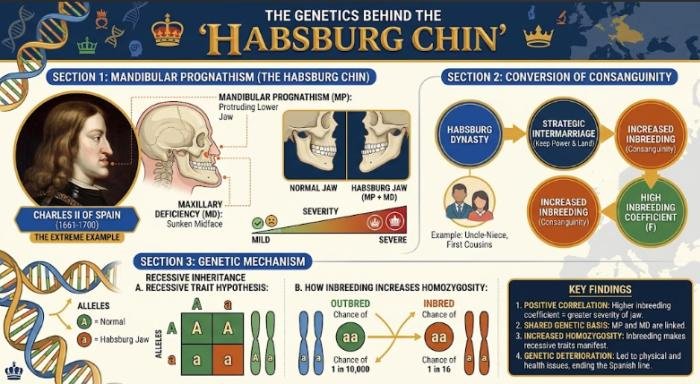
One of the most interesting questions is whether the characteristic facial appearance was inherited.The answer is that genetics almost certainly matters to facial development in general, but there is no sound basis for saying that the Habsburgs possessed one unique gene responsible for the appearance.
Research into mandibular prognathism in other populations has identified multiple potentially relevant genetic regions and candidate genes. Reviews of the literature describe the condition as having a potentially multifactorial or polygenic background, with genetic influences interacting with other developmental factors.This broader scientific context helps explain why the Habsburg case should not be reduced to a single mutation.
Is the Habsburg Chin Genetic?
The best answer is probably influenced by genetics, but not explained by one known gene.Facial development involves many biological processes. The growth of the mandible, maxilla, skull base, teeth, muscles, and surrounding tissues all contribute to facial appearance.
Mandibular prognathism itself has been observed in families and has been studied using genetic linkage and candidate-gene approaches. Researchers have proposed multiple genetic pathways rather than one universal genetic explanation.
The Habsburg evidence adds another layer because the family had an unusually detailed pedigree. This allowed researchers to compare facial characteristics with estimated levels of relatedness.
What the 2019 Habsburg Study Found
A 2019 study specifically investigated whether the Habsburg jaw was associated with inbreeding.Researchers examined 15 members of the Habsburg dynasty and quantified mandibular prognathism and maxillary deficiency using 66 portraits. They reported a statistically significant correlation between mandibular prognathism and maxillary deficiency.
More importantly, the researchers found that mandibular prognathism showed a statistically significant positive relationship with the pedigree-based inbreeding coefficient. Their findings suggested an association between the Habsburg facial phenotype and increased homozygosity.
The study concluded that both mandibular prognathism and maxillary deficiency contributed to the traditional Habsburg jaw appearance, while the lower third of the face showed greater sensitivity to the estimated degree of inbreeding.
Why the Genetics Story Is More Complicated
An association is not the same as proof of a single causal mechanism.The 2019 study did not identify a unique “Habsburg chin gene.” Instead, it compared facial characteristics with pedigree-based estimates of inbreeding.
A high degree of relatedness can increase homozygosity and can make certain recessive genetic variants more likely to be expressed. But facial morphology is biologically complex. Different genes and developmental processes can influence jaw growth, and similar facial characteristics can arise in unrelated families.
Therefore, the most defensible conclusion is that inbreeding likely contributed to the genetic circumstances surrounding the Habsburg facial phenotype, but the appearance cannot be attributed to one simple gene or one isolated cause.
How Inbreeding May Have Influenced the Habsburg Family
Inbreeding occurs when individuals with shared ancestry reproduce. The closer the relationship, the greater the chance that offspring inherit copies of the same genetic variants from both parents.
This does not mean that every inherited trait becomes abnormal. Rather, increased homozygosity can increase the probability that harmful recessive variants will be expressed.This principle is important in interpreting the Habsburg dynasty.
Charles II’s High Inbreeding Coefficient
The 2009 pedigree study found that the estimated inbreeding coefficient of Spanish Habsburg kings increased markedly over successive generations. Philip I had an estimated coefficient of 0.025, while Charles II reached 0.254. Several other members also had coefficients above 0.20.
The researchers also reported evidence of inbreeding depression affecting survival to age 10 among the offspring of Spanish Habsburg kings.These findings concern the broader biological consequences of repeated consanguinity. They should not be interpreted as proof that every physical feature in the dynasty resulted from inbreeding.
Was Inbreeding Responsible for Charles II’s Health Problems?
Researchers have proposed genetic explanations for several aspects of Charles II’s documented health history, particularly in light of his exceptionally high pedigree-based inbreeding coefficient.
The PLOS ONE study proposed that two rare recessive disorders could potentially explain much of his reported clinical history. The authors explicitly characterized parts of this explanation as speculative.That qualification matters.
Historical medical reconstruction cannot provide the same certainty as examining a living patient using modern diagnostic tools. Contemporary descriptions can be incomplete, biased, or difficult to interpret using modern medical categories.
The safest conclusion is that Charles II’s exceptionally high level of relatedness provides a plausible genetic context for some of his health problems, while the exact diagnosis of individual historical symptoms remains a matter of scholarly interpretation.
Habsburg Chin, Maxillary Deficiency, and Facial Structure
The shape of the human face depends on relationships among multiple bones and tissues.A person can appear to have a strong or projecting chin because the mandible projects forward, because the upper jaw sits farther back, or because both features occur together.This is why the 2014 Habsburg study was significant.
Mandibular Prognathism
Mandibular prognathism refers to forward projection of the lower jaw relative to the craniofacial framework.It can produce a prominent lower facial profile and is commonly discussed in relation to skeletal Class III patterns.
However, research into mandibular prognathism outside the Habsburg family indicates that its causes are not straightforward. Genetic studies have identified multiple candidate regions, and reviews describe interactions among genetic, epigenetic, and environmental influences.
Maxillary Deficiency
Maxillary deficiency involves reduced forward projection of the upper jaw.If the upper jaw is positioned farther back, the lower jaw can appear more prominent even if the mandible is not excessively large.
The 2014 portrait study found evidence of maxillary deficiency in six of seven assessed Habsburg rulers and therefore argued that this feature may have played a larger role than absolute mandibular overgrowth.This helps explain why the phrase Habsburg chin can be misleading if interpreted as meaning simply “an unusually large chin.”
Famous Habsburgs Associated With the Facial Trait
Several members of the Spanish Habsburg dynasty appear in discussions of the characteristic facial profile.
Charles II of Spain: Charles II is probably the most famous historical example.He was born in 1661 and became the final Spanish Habsburg king. His portraits and historical descriptions have made him central to discussions of the Habsburg facial phenotype.
Charles II’s genealogy was unusually concentrated because of the repeated marriages between relatives within previous generations. The 2009 pedigree study calculated his estimated inbreeding coefficient at 0.254, the highest value reported among the Spanish Habsburg kings in that analysis.
His case is therefore important both historically and genetically, but his individual appearance should not be used as a stereotype for the entire dynasty.
Philip IV of Spain: Philip IV was another important Spanish Habsburg ruler whose portraits contribute to the historical record of the dynasty’s facial characteristics.His place in the family tree also illustrates how relatedness accumulated over generations.
Portrait evidence from rulers such as Philip IV helped researchers compare facial morphology across generations rather than relying exclusively on the appearance of Charles II.
Other Spanish Habsburgs: The facial characteristics were not identical among all members of the dynasty.The 2019 study examined 15 Habsburgs, while the 2014 study analyzed portraits representing seven rulers. These studies demonstrate variation in the degree and combination of facial features.That variation is another reason why descriptions such as “every Habsburg had the same chin” are historically and scientifically inaccurate.
Habsburg Chin vs. Other Causes of a Prominent Chin
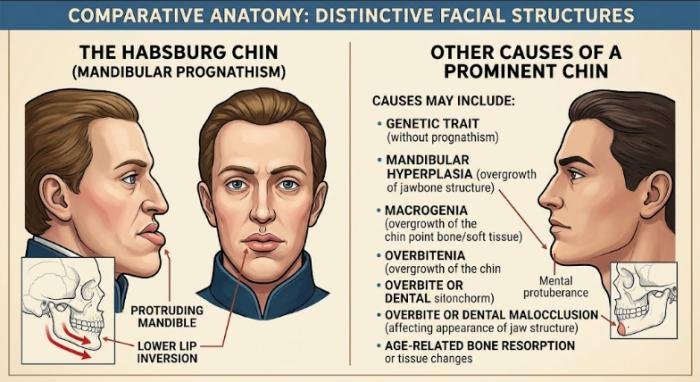
A prominent chin is not unique to the Habsburg family.Human facial anatomy varies considerably among individuals and populations. A person may naturally have a strong chin or a prominent lower jaw without having any connection to the Habsburg dynasty.
Genetics and Normal Facial Variation
Facial morphology is influenced by numerous genetic and developmental factors.Mandibular prognathism has been reported in unrelated families, and genetic research suggests that multiple genomic regions can contribute to susceptibility.Therefore, seeing a similar facial profile in a modern person does not establish Habsburg ancestry.
Why Appearance Cannot Prove Ancestry
Physical appearance is not a reliable substitute for genealogy.Facial features are shared among unrelated individuals, and many traits have multiple genetic and developmental pathways.
If someone wants to establish ancestry, genealogical records and appropriately interpreted genetic testing are much stronger forms of evidence than comparing a person’s chin with historical portraits.
Habsburg Chin vs. Habsburg Jaw: What’s the Difference?
| Term | Meaning | Best Context |
| Habsburg chin | Informal description of a prominent lower-face or chin appearance associated with the Habsburgs | Popular history |
| Habsburg jaw | Historical eponym associated with the characteristic Habsburg facial profile | Historical and medical literature |
| Mandibular prognathism | Forward projection of the lower jaw | Anatomical and clinical terminology |
| Maxillary deficiency | Reduced forward projection of the upper jaw | Anatomical and clinical terminology |
Common Myths About the Habsburg Chin
Myth: Every Habsburg Had the Same Chin
The historical evidence does not support this.The degree of facial characteristics varied between individuals. Studies examining portraits found different combinations and severities of mandibular and maxillary features.
Myth: There Was a Single “Habsburg Chin Gene”
There is no established evidence for one gene uniquely responsible for the facial appearance of the Habsburgs.Research into mandibular prognathism more generally points toward a complicated genetic architecture involving multiple possible loci and candidate genes.
Myth: Inbreeding Automatically Produces a Habsburg Chin
Inbreeding does not automatically create a particular facial feature.Its biological significance is that it increases homozygosity and can increase the chance that certain recessive variants are expressed. The 2019 Habsburg study found an association between inbreeding and mandibular prognathism in its historical sample, but that does not mean that every person with a prominent chin is inbred.
Myth: Charles II’s Appearance Explains Everything About the Dynasty’s Collapse
The extinction of the Spanish Habsburg line was a historical and biological process involving succession, reproductive failure, health, and the dynasty’s accumulated genealogy.The pedigree study found evidence consistent with significant inbreeding effects, but reducing the dynasty’s history to one facial feature would be misleading.
What Modern Science Can and Cannot Tell Us
Modern research has made the Habsburg facial story more precise, but it has not answered every question.
What Portrait Studies Can Tell Us
Researchers can compare recurring anatomical characteristics across portraits and generations.The 2014 and 2019 studies demonstrate that systematic portrait analysis can produce measurable observations about facial morphology.
This is considerably stronger than simply selecting one famous painting and making a subjective judgment.
What Portrait Studies Cannot Prove
Historical paintings cannot provide a complete genetic diagnosis.They cannot reliably reveal an individual’s:
- Complete DNA sequence
- Exact skeletal dimensions
- Complete dental history
- Hormonal profile
- Soft-tissue anatomy
- Entire medical history
Why Scientific Caution Matters
The Habsburg story is fascinating precisely because history and genetics intersect, but that makes careful wording even more important.The strongest evidence comes from combining several types of information: genealogical records, historical portraits, peer-reviewed anatomical research, and population or genetic research.
Conclusion:
The Habsburg chin remains one of the most recognizable physical characteristics associated with European royal history, but its real story is more nuanced than the popular legend.
The Habsburg dynasty’s repeated consanguineous marriages created an unusually concentrated family pedigree. Historical portraits provide a rare visual record across generations, allowing researchers to study recurring facial characteristics. Modern studies have found evidence that the traditional Habsburg jaw appearance involved both mandibular prognathism and maxillary deficiency, rather than simply an excessively large lower jaw.
Genetic research also supports a meaningful connection between the dynasty’s high degree of relatedness and some aspects of its physical and biological history. The estimated inbreeding coefficient of 0.254 for Charles II illustrates just how closely interconnected the Spanish Habsburg pedigree had become by the final generation.
Yet the evidence does not justify describing the Habsburg chin as the product of a single gene or assuming that every Habsburg shared exactly the same facial structure. Human facial development is complex, and mandibular prognathism itself can involve multiple genetic and environmental influences.
Ultimately, the Habsburg chin is best understood as part of a much larger story involving royal genealogy, historical portraiture, craniofacial development, genetics, and the consequences of repeated dynastic marriage. That combination of history and science is what makes the subject so enduring—and why careful evidence matters more than the myths that have grown around it.
Frequently Asked Questions About the Habsburg Chin
Q1: What is a Habsburg chin?
Ans: A Habsburg chin is an informal term for a prominent lower-face appearance historically associated with members of the Habsburg dynasty. It is closely related to the better-established term “Habsburg jaw.” Modern research indicates that both mandibular prognathism and maxillary deficiency may contribute to the characteristic appearance.
Q2: Is the Habsburg chin the same as the Habsburg jaw?
Ans: They are often used interchangeably in popular writing, but “Habsburg jaw” is the more established historical and medical expression. “Habsburg chin” is mainly a descriptive term focused on the visible lower-face appearance.
Q3: Was the Habsburg chin caused by inbreeding?
Ans: Research suggests a relationship between inbreeding and the Habsburg facial phenotype, but the claim needs qualification. A 2019 study found a statistically significant association between mandibular prognathism and pedigree-based inbreeding among 15 Habsburgs. It did not identify a single gene or prove that inbreeding alone caused the feature.
Q4: Who is most famous for having the Habsburg chin?
Ans: Charles II of Spain is the most frequently discussed example. He was the last Spanish Habsburg king, and his portraits and genealogy have played an important role in historical and genetic research concerning the dynasty.
Q5: What is mandibular prognathism?
Ans: Mandibular prognathism is a condition in which the lower jaw projects forward relative to the normal craniofacial relationship. Research indicates that its development can involve multiple genetic and environmental factors rather than one universal cause.
Q6: What is maxillary deficiency?
Ans: Maxillary deficiency refers to reduced forward development or projection of the upper jaw. It can make the lower jaw and chin appear more prominent. A study of Spanish Habsburg portraits found evidence that maxillary deficiency was an important part of the traditional Habsburg jaw appearance.
Q7: Did all Habsburgs have a prominent chin?
Ans: No. The dynasty contained considerable individual variation. Studies of Habsburg portraits found different degrees of mandibular prognathism and maxillary deficiency among the individuals examined.
Q8: Did Charles II have the highest level of inbreeding in the Spanish Habsburg dynasty?
Ans: In the major 2009 pedigree analysis, Charles II had the highest estimated inbreeding coefficient among the Spanish Habsburg kings, at 0.254. The calculation was based on an extensive reconstructed pedigree rather than direct whole-genome sequencing.
Q9: Can a person have a Habsburg-like chin without being related to the Habsburgs?
Ans: Yes. Similar facial characteristics occur in unrelated people. Mandibular prognathism and other facial traits have complex genetic backgrounds, so appearance alone cannot establish Habsburg ancestry.
Q10: Did the Habsburg chin cause the end of the dynasty?
Ans: No. The facial feature itself did not cause the dynasty’s end. The Spanish Habsburg line ended when Charles II died without a surviving heir in 1700. Research suggests that extensive inbreeding may have contributed to health and reproductive problems in the dynasty, but the historical outcome cannot be reduced to the Habsburg chin.
