The Mellon Foundation is one of the major philanthropic organizations supporting arts, culture, humanities, and higher learning in the United States. For nonprofits, universities, museums, artists, researchers, and cultural organizations, knowing how its grantmaking works can be useful when deciding whether a project fits a potential funder.
This guide explains what the foundation does, where its funding goes, how grant seekers should assess fit, and what recent grantmaking says about its priorities. It also goes beyond a simple list of programs by showing how to evaluate a proposal from a funder’s perspective.
Read More: Jstor stand for: Meaning, Uses, History & Research Guide
What Is the Mellon Foundation?
The Mellon Foundation, formally the Andrew W. Mellon Foundation, is a philanthropic foundation established in 1969 by Ailsa Mellon Bruce and Paul Mellon. It was created through the consolidation of the Avalon Foundation and the Old Dominion Foundation, with the new foundation named for their father, Andrew W. Mellon.
Its long-standing purpose has centered on strengthening the arts and humanities. Today, the organization describes its mission around building just communities through grants that allow ideas, imagination, critical thinking, and cultural expression to flourish.
The foundation is notable for the breadth of its grantmaking. Rather than concentrating on a single discipline, it supports connected areas such as arts and culture, higher learning, humanities in place, public knowledge, and selected presidential initiatives.
History and Evolution
The foundation’s history helps explain why its present-day programs are broader than conventional arts philanthropy. Paul Mellon had a strong interest in higher education, the humanities, and the arts. Before the 1969 consolidation, the Old Dominion Foundation supported higher education, humanities and liberal arts, museums, research, publications, conservation, and related causes.
Since its founding, Mellon has continued that connection between scholarship and cultural life while changing its strategies in response to social and institutional needs. In recent years, social justice has become an explicit priority across its grantmaking, building on earlier work around access to higher education, arts, and humanities.
What Is the Foundation’s Mission?
The foundation’s mission is rooted in the belief that arts and humanities are central to human expression and democratic society. Its grants aim to support communities where ideas and imagination can thrive.
That mission matters for grant seekers because a project can be technically strong yet still be a poor fit if it does not connect to the foundation’s current goals. A useful way to interpret the mission is through four questions:
- Does the project strengthen arts, culture, humanities, learning, or public knowledge?
- Does it create meaningful value for a community or public?
- Does it address a genuine cultural, educational, historical, or social need?
- Can the organization demonstrate the expertise and partnerships required to deliver it?
Mellon Foundation Grantmaking Areas
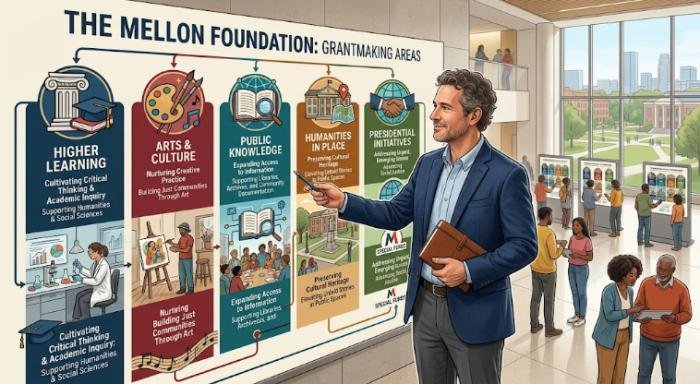
The foundation currently organizes much of its work through four core grantmaking areas, alongside presidential initiatives.
Arts and Culture
Arts and Culture supports creative ecosystems and the people and organizations that sustain them. This can include cultural institutions, artistic work, and initiatives that strengthen access to creative expression.
For applicants, the practical lesson is to explain not only what artistic activity will happen but why it matters. A proposal becomes stronger when it connects artistic work with audiences, communities, cultural memory, or long-term field development.
Higher Learning
Higher Learning focuses on knowledge production and the humanities within higher education and related settings. Its history includes long-term efforts to broaden opportunity and strengthen the humanities.
An effective higher-learning proposal should clearly define the educational or scholarly challenge, identify who benefits, and explain how the project could improve teaching, research, institutional practice, or access to knowledge.
Humanities in Place
Humanities in Place emphasizes the relationship between stories, communities, geography, and public life. The program reflects an important idea: where history is told and whose experiences are represented can shape how communities understand themselves. Projects in this area may benefit from strong local partnerships, community participation, historical research, and a clear plan for public engagement.
Public Knowledge
Public Knowledge supports efforts that preserve, organize, share, and expand access to knowledge. Libraries, archives, digital humanities projects, and other public-facing knowledge work can fit within this broad purpose when aligned with current program priorities.
For a digital archive project, for example, an applicant should explain the significance of the material, the communities connected to it, the technical approach, access strategy, preservation plan, and expected public benefit.
Presidential Initiatives
Presidential initiatives allow the foundation to concentrate resources on defined issues that intersect with arts, culture, knowledge, and justice. Current initiatives include areas such as Imagining Freedom and work connected to Puerto Rico, among others.
These initiatives can be especially important for organizations working on a clearly defined contemporary issue. However, applicants should always verify the current initiative list and eligibility rules because program structures can change.
Mellon Foundation Grants: Who Can Receive Funding?
The foundation states that most of its grants go to organizations in the United States that qualify as IRS section 501(c)(3) public charities, as well as organizations outside the United States that are equivalent to U.S. public charities. There are important limitations. The foundation says it does not fund tuition, K–12 education and programming, fundraising events, or direct unrestricted funding for individuals.
Most grants are made through invitations, although the foundation sometimes issues open calls for proposals. This distinction is crucial. Searching for a generic application form and sending an unsolicited proposal may not be the most effective approach. A better strategy is to identify a relevant program, monitor official announcements, study funded work, and determine whether the organization has a genuine fit.
How to Find Mellon Foundation Funding Opportunities
A practical funding search can follow five steps.
1. Start With Program Fit: Do not begin with the amount of money you need. Begin with the problem your project addresses and identify which current grantmaking area is closest to that problem.
2. Read Current Eligibility Rules: Check the official grant-seeker information for organization type, geographic scope, proposal requirements, and whether the opportunity is open or invitation-based.
3. Study Previous Grantees: The foundation maintains a grant database. Reviewing comparable awards can help you understand the kinds of organizations, projects, partnerships, and outcomes that have received support.
4. Build a Specific Case: A strong case connects need, project design, public value, organizational capacity, and measurable outcomes.
5. Monitor New Calls: Because most grants are invitation-based and open calls can appear for particular initiatives, organizations should monitor official announcements rather than relying on old grant articles.
How to Write a Strong Grant Proposal
A competitive proposal should answer five basic questions clearly.
What Problem Are You Addressing?
Describe a real and well-supported challenge. Avoid broad claims such as “our community needs more culture” without evidence.
Why Does the Solution Matter?
Explain what will change if the project succeeds. Connect activities to meaningful outcomes.
Why Is Your Organization Suited to Lead It?
Demonstrate relevant experience, partnerships, staff expertise, community relationships, or access to important collections and audiences.
Who Benefits?
Identify the communities, students, researchers, artists, audiences, or institutions that will gain from the work.
How Will You Measure Progress?
Use practical indicators. Depending on the project, these might include participation, access, preservation milestones, scholarly outputs, educational use, artist employment, or community engagement.
Practical Example: A Community Digital Archive
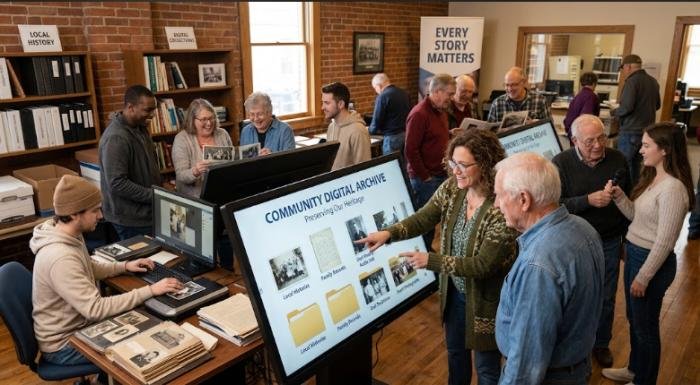
Imagine a nonprofit historical organization wants to digitize photographs, oral histories, and documents from a neighborhood whose history is poorly represented in public collections. A weak proposal might simply ask for funds to buy scanners and build a website.
A stronger proposal would explain that the project addresses a documented preservation gap, involves residents in identifying and describing materials, uses appropriate digital preservation standards, provides public access, and creates educational resources for local schools and researchers.
The project could then define measurable outcomes such as the number of collections digitized, the percentage made publicly accessible, the number of community contributors, educational uses, and preservation milestones.
Foundation Funding in Recent Years
Recent figures show the scale of the foundation’s activity. Its official mission page reports $555 million awarded in 2024 and more than 19,000 grants funded since its founding. The 2025 annual report says the foundation issued more grants in 2025 than in any other year in its history and reached hundreds of nonprofit organizations.
The foundation’s 2025 report also highlights several examples of large-scale commitments. These included $25 million for paid internships for humanities majors at public colleges and universities, more than $26 million for American museums, and $12 million for community-based archives. The Monuments Project remains another major example.
The foundation describes it as a $500 million commitment, with more than $250 million in grants issued under the initiative by 2025. These figures show that its impact is not limited to conventional institutional grants. Its portfolio can include workforce development, museums, archives, public history, literary arts, cultural infrastructure, and community-centered projects.
Foundation Financial Strength and Grantmaking Capacity
The foundation’s financial position helps explain its ability to make large, long-term commitments. According to its financial information, its endowment was approximately $7.8 billion at the end of 2025, while it had awarded about $9.1 billion in grants from 1969 through 2023.
For organizations, the takeaway is not that a large endowment means funding is easy to obtain. Philanthropic capacity and grant eligibility are different questions. A large foundation can still be highly selective because it has strategic priorities, limited staff capacity, and a defined grantmaking model.
Foundation vs. Traditional Grant Funders
One useful comparison is between Mellon-style strategic philanthropy and a conventional open-call grant program.
| Factor | Mellon-style strategic grantmaking | Typical open-call funder |
| Access | Often invitation-based | Usually open during stated periods |
| Selection | Strong emphasis on program fit | Usually based on published scoring criteria |
| Relationship | Can involve long-term partnership | Often centered on application and reporting |
| Project fit | Must align with current priorities | Must meet stated eligibility and goals |
| Best preparation | Research, relationships, program alignment | Strong application against published criteria |
How Organizations Can Improve Their Funding Strategy
A better funding strategy begins with alignment rather than wishful thinking. First, create a one-page project summary that states the problem, proposed response, beneficiaries, partners, expected outcomes, and approximate budget. Second, map that project against current program priorities. If the connection requires several paragraphs to explain, the fit may be weak.
Third, review funded projects that resemble your work. Look for patterns in scale, geography, partnerships, audience, and type of impact. Fourth, strengthen evidence. A proposal supported by community research, participation data, scholarly evidence, or demonstrated demand is more persuasive than one built mainly on assertions.
Fifth, plan for sustainability. Explain how the work will continue, be maintained, shared, or adapted after the initial funding period. Finally, avoid copying language from old applications or outdated web pages. Current priorities matter more than historical descriptions.
Mellon Foundation Impact on Arts, Culture, and Humanities
The foundation’s impact can be seen at several levels. At the institutional level, grants can help museums, universities, archives, cultural organizations, and other nonprofits undertake projects that might otherwise be difficult to finance. At the individual level, philanthropy can support artists, scholars, cultural workers, students, and community leaders through programs designed around particular fields or needs.
At the public level, projects can make historical materials accessible, broaden cultural representation, strengthen public spaces, and create opportunities for communities to tell their own stories. The 2025 annual report provides concrete examples, including support for community-based archives, museums, literary organizations, and cultural projects in places that receive comparatively less philanthropic attention.
What Makes the Foundation Different?
The most important difference is not simply the size of its endowment. It is the combination of subject expertise, long-term relationships, and a willingness to make sizable commitments around specific ideas. The foundation says its staff are deeply immersed in the fields where it invests.
That has an important implication for applicants: a proposal should demonstrate that the organization understands its own field, not merely that it needs funding. A sophisticated proposal therefore treats the funder as a potential intellectual and strategic partner. It identifies a meaningful opportunity, demonstrates why the applicant is positioned to act, and explains how the work can contribute to a broader field.
Common Mistakes Grant Seekers Should Avoid
Applying Without Checking the Current Program: A program page from several years ago may no longer reflect current priorities. Always use current official information.
Treating Funding as a General Operating Rescue: If a project does not fit the foundation’s charitable purposes and current priorities, financial need alone is unlikely to create a strong case.
Focusing Only on Activities: Listing workshops, exhibitions, digitization, conferences, or publications is not enough. Explain the change those activities are intended to produce.
Ignoring Community Voice: For place-based or public-facing projects, community participation can be central to credibility and impact.
Using Inflated Impact Claims: Avoid promises that cannot be measured. Specific, realistic outcomes are more credible.
Forgetting the Long-Term Picture: Funders want to know what happens to the work after a grant period. Preservation, maintenance, staffing, partnerships, access, and future funding should be considered early.
Conclusion
The Mellon Foundation occupies an influential place in American philanthropy because its work connects arts, culture, humanities, higher learning, public knowledge, and community life. Its grantmaking is substantial, but its funding model is selective and strongly shaped by program priorities.
For organizations considering a funding relationship, the most useful approach is not to ask only, “How much funding is available?” A better question is, “How closely does our work align with the foundation’s current purpose, and what distinctive public value can we demonstrate?”
That shift—from seeking money to demonstrating meaningful impact—can improve the quality of any grant strategy. Before submitting information or making decisions based on this article, verify current eligibility, program names, funding opportunities, deadlines, and application procedures directly with the foundation. Official sources should take precedence over older articles, third-party summaries, or archived grant information.
FAQs about mellon foundation
Q1: What is the Mellon Foundation?
Ans: The Andrew W. Mellon Foundation is a philanthropic foundation established in 1969 that supports arts, culture, humanities, higher learning, public knowledge, and related initiatives through charitable grantmaking.
Q2: What does the Mellon Foundation fund?
Ans: Its current grantmaking includes Arts and Culture, Higher Learning, Humanities in Place, Public Knowledge, and selected Presidential Initiatives. Specific funding priorities and opportunities can change.
Q3: Who is eligible for Mellon Foundation grants?
Ans: The foundation says most grants go to U.S. 501(c)(3) public charities and equivalent organizations outside the United States. Eligibility can vary by program.
Q4: Can individuals apply for Mellon Foundation grants?
Ans: The foundation states that it does not provide direct unrestricted funding for individuals. Some programs may support individuals through specific structures, so applicants should check the current rules for the relevant initiative.
Q5: Does the Mellon Foundation accept unsolicited proposals?
Ans: Most grants are made through invitations. The foundation occasionally issues open calls for proposals, so organizations should monitor its official grant-seeker information.
Q6: How can an organization improve its chance of receiving funding?
Ans: Start with strong program alignment, demonstrate a genuine public or field-level need, provide evidence, identify capable partners, define measurable outcomes, and follow the current funding process precisely.
Q7: How much does the Mellon Foundation award?
Ans: Grant amounts vary substantially by program and project. The foundation reported $555 million awarded in 2024, while its 2025 annual report describes several major multi-million-dollar commitments.
Q8: Where can I find current foundation grant information?
Ans: The most reliable source is the foundation’s official grant-seeker and grantmaking pages, along with its grant database, current announcements, and annual reports.