
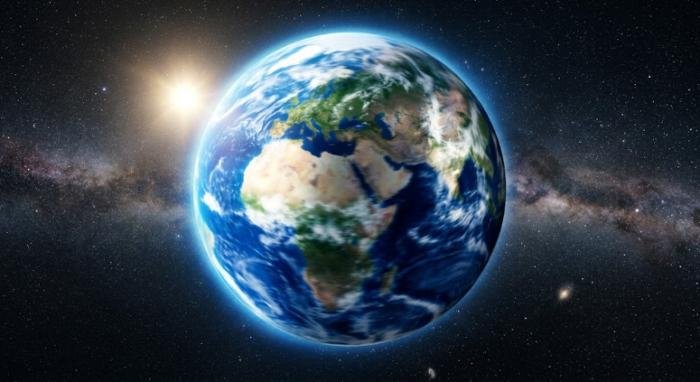
Earth does not rotate at exactly the same speed every day. Although we commonly think of a day as a fixed 24-hour period, the planet’s rotation varies by tiny amounts because Earth is a dynamic system made of a solid crust and mantle, a moving liquid outer core, oceans, atmosphere, ice, groundwater, and other components.That is why scientists sometimes record days that are slightly shorter than 86,400 SI seconds. On June 29, 2022, for example, Earth completed a rotation about 1.59 milliseconds faster than a standard 24-hour day. It was the shortest day recorded in the modern atomic-clock era, according to NASA and NIST.
But this does not mean Earth has suddenly entered a permanent period of faster rotation. Earth’s spin fluctuates naturally, while the much longer-term trend has generally been toward slower rotation because of tidal friction caused primarily by the Moon.So why does Earth’s rotation sometimes speed up? How do scientists measure such a tiny change? Could it affect clocks, GPS, satellites, or everyday life? And how does climate change fit into the picture?The answers are more interesting—and more complicated—than the phrase earth spinning faster might suggest.
Read More: Best Mothers Day Gifts for Every Type of Mom in 2026
What Does “Earth Spinning Faster” Actually Mean?
Earth rotates around an imaginary line called its rotational axis. One complete rotation relative to the Sun is approximately a day, but the exact rotational behavior of the planet is not perfectly uniform.Scientists describe these variations using Length of Day (LOD). The International Earth Rotation and Reference Systems Service, or IERS, defines LOD as the difference between a day measured through Earth’s rotation and exactly 86,400 SI seconds. It is commonly expressed in milliseconds per day.
If Earth’s solid surface completes its rotation slightly faster than usual, the LOD becomes shorter. If it rotates more slowly, the LOD becomes longer.That produces a simple relationship:
Faster rotation → slightly shorter rotational day
Slower rotation → slightly longer rotational day
The changes are extremely small. A difference of one millisecond is just one-thousandth of a second. Humans cannot feel such a change, and it does not suddenly give people less usable time in their daily routines.What matters is that modern scientific instruments are sensitive enough to measure these variations accurately.
Is Earth Really Spinning Faster?
Yes, Earth’s rotation can temporarily speed up, and precise measurements have confirmed periods when the planet completed a rotation faster than the standard 86,400-second day.However, saying simply that “Earth is spinning faster” can be misleading.There are two different ideas to keep separate:
- Short-term changes in Earth’s rotation
- The long-term evolution of Earth’s rotation
Short-term variations can make some days shorter than average. But over very long periods, Earth’s rotation has generally slowed.
NASA’s Earth Science data notes that the June 29, 2022, short day was the shortest recorded in the modern atomic-clock era, but also emphasizes that Earth’s LOD naturally fluctuates. NASA identifies several possible contributors to periods of increased rotational speed, including geophysical processes, hydrological changes, post-glacial rebound, and changes associated with Earth’s Chandler wobble.
NIST similarly notes that although the 2022 measurement was unusual, it did not mean that days would continue getting shorter indefinitely. Historical measurements show that the average day has generally lengthened over much longer periods.
The 2022 short-day record
On June 29, 2022, Earth’s rotation was approximately 1.59 milliseconds shorter than 24 hours.In other words, compared with the 86,400 SI seconds used as the standard length of a day, Earth completed that particular rotation slightly sooner.
That number may sound insignificant, but for Earth scientists and precision timekeepers, it is important.A millisecond represents a thousandth of a second. When instruments can detect changes that small across the entire planet, researchers can use them as clues about processes occurring inside and on Earth’s surface.NIST describes the June 29 measurement as a noteworthy event in the era of atomic clocks, while NASA stresses that it was not the shortest day in Earth’s entire history.
Why Is Earth Spinning Faster?
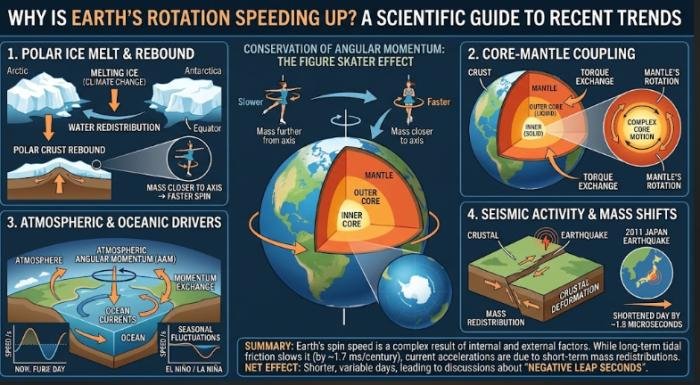
There is no single explanation for every episode of faster rotation.Earth’s rotational speed changes because angular momentum is exchanged among different parts of the Earth system. The atmosphere, oceans, solid Earth, core, ice, groundwater, and other components can all play roles at different timescales.
Earth’s core can influence rotation
Deep beneath Earth’s surface lies the liquid outer core, composed largely of iron and nickel. Motion within this layer is closely connected with Earth’s magnetic field and can exchange angular momentum with the mantle above it.
NASA research has found that long-period changes in Earth’s day length cannot be explained entirely by atmospheric and oceanic processes. Variations in the flow of liquid iron in the outer core are an important factor in longer-term changes in Earth’s rotation.The basic idea is that Earth’s interior is not stationary.
Different layers can move relative to one another. When angular momentum is transferred between the core and the mantle, the rotation rate of the solid Earth can change slightly.This is one reason scientists do not treat Earth as a simple spinning sphere.
Atmospheric winds can change the length of a day
The atmosphere is constantly moving around the planet.
Large-scale winds, changes in atmospheric pressure, seasonal circulation, and weather patterns can exchange angular momentum with the solid Earth. When the atmosphere gains or loses angular momentum, the solid planet can respond with a small change in its rotation rate.
NASA research shows that atmospheric and oceanic processes can produce measurable changes in LOD, including seasonal variations of roughly a millisecond over the course of a year.Weather therefore does not merely happen on a rotating planet. The movement of the atmosphere can also influence how that planet rotates.
Water and ice can redistribute Earth’s mass
The distribution of mass across Earth also affects its rotation.A useful analogy is an ice skater spinning on a rink. When the skater pulls their arms closer to their body, their rotation speeds up. When they extend their arms, their rotation slows.
Earth follows the same basic physics.If mass moves closer to or farther from the rotational axis, Earth’s moment of inertia changes, which can influence its spin rate.
NASA explains that melting land ice can affect Earth’s rotation when the resulting water moves into the oceans. The redistribution of that water changes how mass is arranged around the planet.
How Climate Change Is Connected to Earth’s Rotation
Climate change does not simply make Earth spin faster.In fact, recent NASA-funded research shows that climate-related redistribution of ice and water tends to slow Earth’s rotation and lengthen the day, even though short-term periods of faster rotation can occur for other reasons.
NASA reported in 2024 that melting glaciers and ice sheets, along with declining groundwater storage, redistribute mass toward the oceans. This changes Earth’s rotation and contributes to longer days. Researchers found that from 2000 to 2018, this climate-related contribution to day-lengthening was about 1.33 milliseconds per century, faster than the corresponding rate during earlier parts of the 20th century.
When land ice at high latitudes melts and the water spreads through the oceans, more mass becomes distributed farther from Earth’s rotational axis. That tends to slow the planet’s spin.NASA’s research also reported that if greenhouse-gas emissions continue to rise, climate-related changes could eventually become a very significant contributor to day lengthening.
So climate change is an important part of the modern Earth-rotation story, but it should not be presented as the sole explanation for every recent change in rotational speed.
Why melting ice does not automatically mean faster rotation
It may seem intuitive that melting ice would make Earth spin faster because a change in mass sounds like it should increase movement.The direction of the effect depends on where the mass moves.When land ice melts and water spreads into the oceans, mass generally moves farther from Earth’s rotational axis. That increases Earth’s moment of inertia and tends to slow rotation.
NASA gives a striking theoretical example: if the Greenland ice sheet completely melted and all the meltwater entered the ocean, Earth’s day would become roughly 2 milliseconds longer than today.This demonstrates why the location and movement of mass matter more than the simple fact that ice is melting.
Earth Spinning Faster vs. Earth’s Long-Term Slowing
One of the easiest ways to misunderstand Earth’s rotation is to assume that a few unusually short days represent a permanent acceleration.They do not.The Moon is the dominant reason Earth’s rotation has generally slowed over geological time.
The Moon’s gravity creates tides, and tidal friction transfers rotational energy and angular momentum away from Earth’s spin. As a result, Earth’s rotation gradually slows and the average day becomes longer.The U.S. Naval Observatory estimates the tidal deceleration associated with Earth’s rotation at roughly 1.5 to 2 milliseconds per day per century, while noting that other factors also affect the observed rotation rate.
This long-term slowing does not prevent temporary periods of faster rotation.A useful way to think about it is like a car moving along a road while its speed fluctuates slightly. The overall direction of a long-term trend and the behavior on individual days do not have to be identical.
| Earth-rotation factor | Typical influence on rotation | Main timescale |
| Lunar tidal friction | Generally slows Earth’s rotation | Very long term |
| Atmosphere and winds | Can speed up or slow down rotation | Days to seasons |
| Ocean circulation and tides | Can alter rotation in either direction | Days to decades |
| Core-mantle interactions | Can alter rotation rate | Years to decades and longer |
| Ice and groundwater redistribution | Generally contributes to slowing when mass moves away from the axis | Years to centuries |
| Post-glacial rebound | Redistributes mass and affects rotation | Centuries to millennia |
How Scientists Measure Earth’s Rotation
Measuring Earth’s rotation to millisecond precision is a major achievement in modern geodesy and astronomy.Scientists use several techniques to determine Earth’s orientation and rotation.
UT1 measures Earth’s rotational time: One of the most important concepts is UT1, a time scale based on Earth’s actual rotation.The U.S. Naval Observatory describes UT1 as a measure of Earth’s rotation angle determined through astronomical observations. Unlike atomic time, UT1 is not perfectly uniform because Earth’s rotational speed varies.
This distinction matters because the second used by modern atomic timekeeping is deliberately uniform, while Earth’s physical rotation is not.The difference between those two systems allows scientists to monitor changes in Earth’s spin.
Very Long Baseline Interferometry: A key measurement technique is Very Long Baseline Interferometry (VLBI).VLBI uses radio telescopes at widely separated locations to observe extremely distant astronomical radio sources, including quasars. By comparing the signals received at different observatories, scientists can determine Earth’s orientation with extraordinary precision.
NASA explains that VLBI is used to monitor how long Earth takes to complete a rotation and that UT1 is based on these measurements.The technique effectively gives scientists a cosmic reference against which Earth’s movement can be measured.
Why quasars are useful: Quasars are extremely distant and appear effectively fixed in the celestial reference frame over the timescales relevant to these measurements.The U.S. Naval Observatory explains that a worldwide network monitors quasars and that IERS combines observations from different facilities to determine Earth’s rotation.This provides a highly stable reference for measuring tiny changes in Earth’s orientation.
The role of IERS: The International Earth Rotation and Reference Systems Service coordinates and publishes important Earth-orientation information.Its data include UT1, length of day, polar motion, and other parameters used by astronomers, geodesists, navigation specialists, and researchers.The U.S. Naval Observatory also provides daily Earth-orientation products containing UT1-UTC and length-of-day measurements.
How Much Faster Is Earth Spinning?
The answer depends on the particular date.Earth’s rotation does not speed up by one fixed amount and remain there. Instead, LOD changes continuously.The June 29, 2022, measurement is one of the clearest examples. Earth completed its rotation approximately 1.59 milliseconds faster than a standard 24-hour day.
That means the difference was only:0.00159 secondsThat is far smaller than the time required for a person to consciously react to an ordinary visual event.So headlines suggesting that Earth suddenly lost a meaningful portion of a day can be misleading.
The planet did not lose a minute.It did not lose an hour.It lost roughly one and a half thousandths of a second relative to the standard 86,400-second day.For everyday life, that difference is effectively invisible. For precision science, however, it is valuable information.
What Is Earth’s Chandler Wobble?
Earth’s rotation involves more than simply turning at a fixed rate around a perfectly stationary axis.The rotational axis also moves slightly relative to Earth’s surface. One component of this motion is called the Chandler wobble.
NASA identifies changes in Chandler wobble among the possible contributors to unusual recent rotational behavior.It is important not to confuse this with the rotational speed itself.
Rotation rate describes how quickly Earth turns.
Polar motion describes changes in the position of Earth’s rotational axis relative to the crust.
Both can be influenced by redistribution of mass and processes inside the planet, but they are different measurements.NASA’s 2024 research showed that changes in ice, groundwater, sea level, and Earth’s interior can influence polar motion as well as the broader behavior of Earth’s rotation.
Why Earth’s Rotation Matters to Scientists
At first glance, a millisecond might seem too small to matter.For Earth scientists, it is extremely useful.A changing rotation rate can provide evidence about processes that cannot be directly observed.For example, scientists cannot simply travel into Earth’s outer core and watch liquid iron flow. But changes in Earth’s rotation can provide indirect information about interactions between the core and mantle.
Likewise, changes in Earth’s rotation can help researchers understand how atmospheric circulation, ocean currents, groundwater, and ice redistribute angular momentum.NASA describes Earth’s rotation measurements as a way to monitor changes throughout the Earth system, while IERS and USNO maintain the precision measurements required for scientific and technological applications.
Conclusion: What Earth Spinning Faster Really Means
The phrase earth spinning faster describes a real but highly nuanced scientific phenomenon.Earth’s rotation is not perfectly constant. Some days are slightly shorter and others slightly longer because angular momentum is continually exchanged among the atmosphere, oceans, solid Earth, core, ice, groundwater, and other components of the planet.
The June 29, 2022, measurement—when Earth completed a rotation about 1.59 milliseconds faster than the standard 24-hour day—demonstrated just how precisely scientists can now measure these changes.But that event does not mean Earth has entered a permanent period of acceleration.
The bigger scientific picture is more complex. Lunar tidal friction has produced a long-term slowing of Earth’s rotation, while atmospheric circulation, ocean processes, core-mantle interactions, hydrological changes, polar motion, and mass redistribution can cause shorter-term fluctuations.
Frequently Asked Questions About Earth Spinning Faster
Q1. Is Earth really spinning faster?
Ans: Earth can temporarily spin faster, and precise measurements have recorded unusually short rotational days. On June 29, 2022, Earth’s rotation was approximately 1.59 milliseconds faster than the standard 24-hour reference. However, this does not mean Earth is permanently accelerating. Its rotation naturally varies, and the long-term trend has generally been toward slower rotation.
Q2. Why is Earth spinning faster?
Ans: There is no single cause. Earth’s rotation is affected by interactions between the core and mantle, atmospheric winds, ocean circulation, tides, groundwater, ice redistribution, post-glacial rebound, and other geophysical processes. Different factors dominate at different timescales.
Q3. How much faster did Earth spin in 2022?
Ans: On June 29, 2022, Earth completed a rotation about 1.59 milliseconds shorter than 24 hours. That equals 0.00159 seconds and was the shortest measured day in the modern atomic-clock era.
Q4. Does faster rotation make Earth’s days shorter?
Ans: Yes. When Earth rotates faster, it completes a rotation in slightly less time, so its measured Length of Day becomes shorter. The changes being discussed are generally measured in milliseconds, making them imperceptible in ordinary daily life.
Q5. Is Earth going to keep spinning faster?
Ans: There is no scientific basis for assuming that Earth’s recent faster rotation will continue indefinitely. Earth’s rotation varies naturally, and different processes can push it in either direction. Over very long periods, lunar tidal friction has generally slowed Earth’s rotation.
Q6. Does climate change affect Earth’s rotation?
Ans: Yes. Climate-related melting of glaciers and ice sheets and changes in groundwater can redistribute mass and influence Earth’s rotation. Recent NASA-funded research found that these processes contribute to longer days by slowing Earth’s rotation. They are one part of a much larger set of influences on Earth’s spin.
Q7. Can Earth’s rotation affect GPS?
Ans: Yes. Precise Earth-orientation measurements are important for satellite navigation, positioning, geodesy, and maintaining accurate reference frames. Ordinary GPS users will not notice millisecond-scale changes, but high-precision systems must account for Earth’s changing orientation.
